Catalog All books
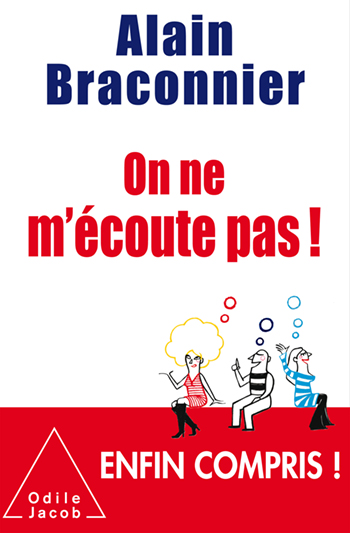
Alain Braconnier
How to Listen and to Be Heard
The right questions to ask ourselves and the qualities to develop in order to be heard. Feeling like we are being heard contributes to our psychological equilibrium, as well as to our self-confidence. This book proposes a method for being heard properly. A reader-friendly book that offers practical advice and recognizes the true value of dialogue in human relations.
Willy Pasini
Liberated and Sometimes Brazen Every nuance of female sexuality
A book that aims to help women overcome the barriers that inhibit them and to show them the way to sexual fulfilment.
Ginette Raimbault
When a child disappears
When a child disappears, the parents of that child have to first of all relearn how to live their lives. How can they face up to this task ? What routes, both conscious and subconscious do they take in order to do this ? Ginette Raimbault explores the mental processes of these devastated parents using the spontaneous testimonies of those who have relied on writing to get them through their bereavement such as Victor Hugo who mourns Léopoldine, and Isadora Duncan and Geneviève Jurgensen who both lost two children at once. Through the anguish of these famous examples, this book movingly asks the universally relevant question : what does a child mean for the parent ?
Bernard Roques
The Danger of Drugs
This book is the result of a study on drugs carried out by Bernard Roques at the request of the French Secretary of State for Health, Bernard Kouchner. The author has reviewed and summarised a large body of information from all over the world, so this is a thorough, detailed scientific examination of what is known today of the potential dangers, particularly for the brain, of toxic and psychotropic drugs including alcohol and tobacco which are often associated with the consumption of other drugs. Roques study will doubtless play a major role in public health discussions and decisions, particularly in the fight against alcoholism and nicotine addiction. Bernard Roques is a member of the French Académie des Sciences.
Jill-Patrice Cassuto
From Mad Cow Disease to Creutzfeldt-Jakob Disease
Jill-Patrice Cassuto examines the precursors of BSE and reviews some of the early research into the disease. He also studies the human form of BSE, or Creutzfeldt-Jakob disease, a fatal neurodegenerative disorder, and addresses the highly controversial question of ways the disease may be transmitted. This book is not only a scientific overview of current knowledge about BSE. It is also a thorough inquiry into the BSE scare and an examination of the issue of responsibility and of how health issues and risks are dealt with within the European Community. Jill-Patrice Cassuto teaches medicine and heads a clinical hematology service in a university hospital.
Janine Thibault
The Air We Breathe
What is air? What is pollution? Whether with regard to the atmosphere, the effects of pollutants, or the weather, teachers will find in this book elementary theoretical information on air, and the essential foundation needed to instruct their pupils with a civic-minded, and preventive attitude to the air they breathe.

Bernard Lechevalier
The Pleasure of Music
From Beethoven to Brassens, including Debussy and Duke Ellington, an exploration of musical pleasure, all genres combined, starting with the emotions that it creates in us, and the meaning that it conveys.
François Dalle, Jean Bounine
Education in Business Against the Unemployment of the Young
Each year in France, 250,000 young people come out of the education system without even a shred of a diploma. The German example and that of Japan shows that the work situation and economic performance are better when schools assure proper instruction and enterprise takes charge of paving the way to employment. François Dalle, President of l'Oréal from 1957 to 1984, and Jean Bounine, advisor to the general directors of this group, are the authors of a 1987 report on employment.
Léo Bersani
Homos Reassessing the Identity
What does it mean to be homosexual today ? Is it necessary to form communities and if so, why ? Is the primary aim equality in society such as it is, or the challenging of society itself ? Up to what point do homosexuals distinguish themselves ? Must there be a link between sexual claims and political dispute ? The gay and lesbian communities necessarily ask themselves these questions. On a wider scale, they also encourage a redefinition of the human being in contemporary societies. Already considered a classic in the United States, Homos presents an innovative, critical reflection on identity and the dangers in the withdrawal of a community from society. An expert in French literature, Leo Bersani is a professor at the University of California. He has notably published Baudelaire and Freud, and Theory and Violence.