Catalog All books
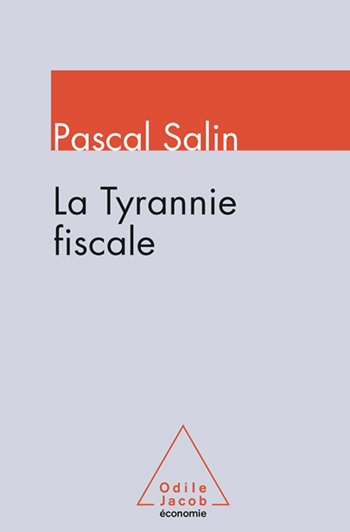
Pascal Salin
Tax Tyranny
Some radical recommendations by an eminent economist for an end to the arbitrary and destructive nature of French fiscal policy
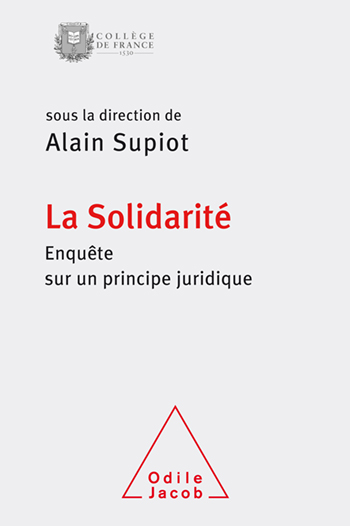
Alain Supiot
Solidarity An Enquiry Into a Legal Principle
A thorough enquiry into the meaning and future of the legal principle of solidarity
Gilles Tétart
The Blood of Poets
The first and constant motive of my scientific life has always been the blood, and its formation, diseases and mutations. During the day, I studied corpuscles and serums. In the evening I read or reread poetry. Sometimes I came across blood once again. An intuition, an allusion of a poet came to clarify my clinical or biological reflections of the next day. These kind of exchanges have inspired this book, which constitutes a personal anthology. It is the same blood which runs in the veins of Iphigenis before the planned sacrifice, as wriggles under our gaze using the microscope, and as draws our eyes to the lips it colours The present anthology bears witness to this unity and this diversity of the blood. Jean Bernard Jean Bernard is a member of the Acadamié française
Hervé de Carmoy
Entreprise, Individual and State Leading to Change
The author believes that France is suffering from numerous ills, including inertia, demagogy, unemployment, corruption, corporotism, elitism, and a general withdrawal from the outside world. He also thinks that much more than clear-headedness and a desire for change are required if a cure is to be found. What is the best way of making the necessary changes? How have others gone about implementing those changes? He believes the business world provides an excellent model for learning how to deal with an ever-changing environment. Hervé de Carmoy was formerly general director of the Midland Bank in London.
George Akerlof, Robert Shiller
Phishing for Phools The Economics of Manipulation and Deception
Deception lies at the heart of the economy
Henri Korn
Promised Lands
From a childhood under the Nazi occupation to great scientific discoveries: a life of passionate curiosity in which nothing is predetermined
John Scheid, Alain Prochiantz
Lights, light
The 2015 Colloquium of the Collège de France unites some of the most eminent authors in physics and astrophysics, in biology, in neuroscience and the history of science. Light is a timeless subject: it has always had the power to fascinate and disturb. Here it is explained.
John Cleese, Robin Skynner
Life and How to Survive It
In Life and How to Survive It, the authors have given us more than 400 pages of lively, tonic humour. Their subject is the joy of living and the conditions required to enjoy life to the full. Proceeding by ever-larger concentric circles, the authors successively discuss happy families (brilliant!), companies that allow their employees to fulfil themselves, and finally countries where life is pleasurable. This is British humour at its best, brilliantlyand hilariouslyillustrated. British comic actor John Cleese is famous for the cult television series Fawlty Towers, which he co-authored and starred in. Robin Skynner is a psychotherapist specialising in group therapies.

Christian Stoffaës
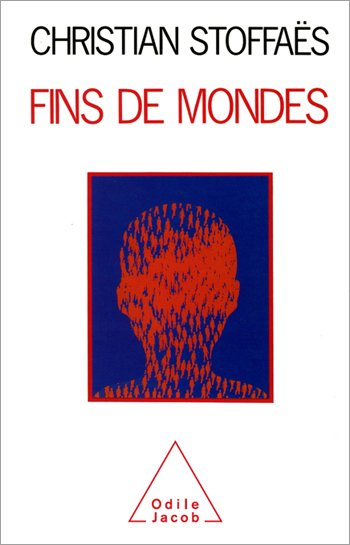
Ends of Worlds
An economic pulse sustains life in the modern world. C. Stoffaës investigates the highs of economic boom and the lows of paralyzing depression. He presents an historical survey of our dominant technological and mental structures from Keynes to Schumpeter, from the steam engine to the microchip, from the American golden age to the new Pacific prosperity.