
Catalog All books
Yves-Alain Fontaine
The Sentimental Evolution
In the course of development, our way of living is fashioned by the world around us, but it is also shaped by discrete characteristics such as nature and the intensity of emotions like anxiety and egoism. From this point of departure, the author draws analogies about the ways in which we are human individuals and members of a species, and proffers the theory that, in the evolutionary process, there is also a sort of anxiety and egoism at work. Evolution, he suggests, might very well be both sentimental and selective. Yves Alain Fontaine is an honorary professor at the National Museum of Natural History.

Marc Bélit
The Love-sick Philosopher
A passionate and poisonous love affair in the world of Parisian intellectuals and political activists, in the late 1970s
Ghislaine Paris
The Importance of Sexuality
Throughout an extended dialogue with a young woman patient, Doctor Ghislaine Paris explains the importance of enjoying a fulfilled sexual existence
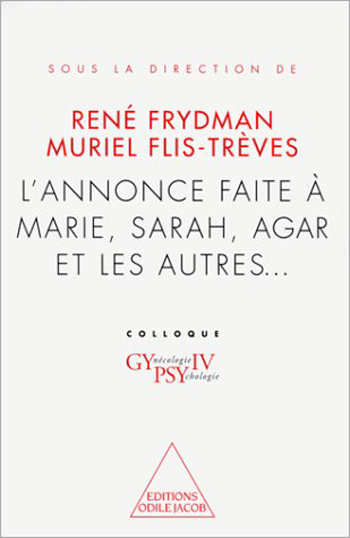
René Frydman, Muriel Flis-Trèves
An Announcement to Marie, Sarah, Agar and the others.... Colloque Gypsy IV
Womens lives are marked by a series of physical events, which may or may not be expected, including pregnancy, illness, foetal malformation or death, and menopause. What effect do these events have? How do women cope and live with them? The reply to these questions is given here by the top specialists in the field, including psychoanalysts, gynaecologists, and philosophers.
Alain Prochiantz
The Anatomies of Thought What do squid think about ?
When we watch a squid facing up to a predator, we see it recoil, agitate the tentacles, spray a jet of ink, and then make use of the temporary blindness of the predator in order to escape to a safe hiding place. Are we able to say what it is thinking ? Evidently, we know that this behaviour is not the result of a reflex unleashed by the sight of an enemy. The mollusc is not however conscious of its acts, at least not in the sense that we, as human beings, understand this term. It is true that we are the product of a evolution of species, and that, although this may not be welcome news for everyone, we share a common ancestry with the octopus, or even the fly. Even if the structure of our cortex, and the invention of language allows us to write about octopuses (or flies), and not the other way round, the fact remains that these evolutive roots, in the same way as other animal species, including invertebrates, have something to teach us about the nature of our thoughts. Alain Prochiantz
Alain Prochiantz
Biology in the Bedroom
Inspiring himself from La Philosophie dans le boudoir by Sade and the major philosophical works of the 18th century, Alain Prochiantz, who is a neurobiologist, explains by means of a dialogue, the progress of embryology and neurobiology and gives us the elements so that we can understand and measure the stakes of the recent discovery of the genes of development. Alain Prochiantz heads the Laboratory for the Development and Evolution of the Nervous System at the École normale supérieure. He is notably the author of Strategies of the Embryo, and Claude Bernard, the Physiological Revolution.

Jean-Claude Hazera
The Lost German Mathurin Capitaine’s First Investigation
A gripping historical thriller set in France in 1944, as the Occupation draws to an end and the Liberation begins