
Catalog All books
Antoine Garapon
Judging Well Essay on Judicial Ritual
Imagine for a moment that you assist at a trial for the first time. There is no doubt that you would be struck by the strange procedure which happens in front of you, the judicial discussions. It is true to say that before being a moral faculty, judging is firstly an event. According to the author, before there were laws, judges and courthouses, there was a ritual. This book aims to unveil all these facets, showing by example how the public gallery is there to culpabilise and inhibit the defendant, in order to make him submit to the judicial order. Can judges avoid staging trials in order to judge well ?




Michel Meyer
Rosewood: The Final Enigma of the Cold War
A gripping thriller that reveals the truth underlying the collapse of the Soviet Empire

Bernard Besson
Greenland
“With an apocalyptic roar, Greenland’s Lauge Koch Kyst region had broken off from the mainland...


Caroline Rebstock
Amber Is Informed
Amber Materson, a young woman in her thirties, learns from a journalist that she is endowed with unique scientific properties: her blood contains stem cells still at the embryonic stage...



Gisèle Gelbert
The Illiterate Brain
Is illiteracy a social scourge, or is it an aphasia-like disorder? To find the answer, Gisèle Gelbert delves into the mysteries of the brain of an illiterate person, and teaches us the art of `repairing' it. By thoroughly breaking down each linguistic act, she is able to define and localise with great accuracy the disorders observed in both written and oral expression. She also makes use of the schema to develop exercices that are especially adapted to the clinical observation of localised disorders, thus opening the door to new therapeutic possiblilities. Gisèle Gelbert is a neurologist and aphasiologist. She is the author of "Lire c'est vivre "(Opus, 1996) and "Lire c'est aussi écrire" (1998).


Christian Saint-Étienne
Europe’s Wild Card The Real Solution to Exit the Economic Crisis
Christian Saint-Etienne argues that the European project was built on a fallacious concept from the start. The premises were false and Europe has become the world’s “soft underbelly”.
André Grimaldi, Didier Tabuteau, François Bourdillon, Frédéric Pierru, Olivier Lyon-Caen
Manifesto for Fair and Egalitarian Healthcare
In the run-up to the French presidential elections, two healthcare specialists denounce the constant and catastrophic deterioration of hospitals in France — and propose effective solutions

Luc Ferry, Axel Kahn
Legalize Euthanasia?
Based on a comparison of euthanasia legislation in several countries and an analysis of specific cases revealing the paradoxes of contemporary individualistic values...
Ilya Prigogine
The End of Certainties (Coll. Opus)
As we come to the end of the century, the question of the future of science is often posed. I believe we are just at the beginning of a new endeavour. We are witnessing the development of a science which is no longer limited to simplified, idealised situations, but makes us face the complexity of the real world. This new science will allow human creativity to be experienced as the unique expression of a fundamental trait common to all aspects of nature. Ive tried to present this conceptual transformation, which implies the beginning of a new chapter in the fruitful relations between physics and mathematics, in a manner that will be comprehensible and accessible to all readers interested in the evolution of our ideas of nature. We are but at the threshold of a new chapter in the history of our dialogue with nature, writes Ilya Prigogine. Ilya Prigogine, winner of the Nobel Prize for Chemistry, teaches at the Free University of Brussels and at the University of Texas, in Austin.

Émile Biasini
Africa and Us
Economist Charles Gide once described colonization as "a force of nature." Biasini believes that to imagine that our current phase of decolonization actually is an end to colonialism is just another manifestation of our society's megalomania. Africa today is going through a phase of change. It must stay faithful to its roots, digesting all the various cultures which have influenced it, while facing a new colonial menace. Its own elites, once fled abroad, have returned to Africa and are quickly becoming the colonists of their own countries. And such colonial ambitions, history teaches us, must inevitably lead to imperialism. Emile Biasini was a civil servant in colonial Africa. Under De Gaulle, he helped found the Ministry of Culture.
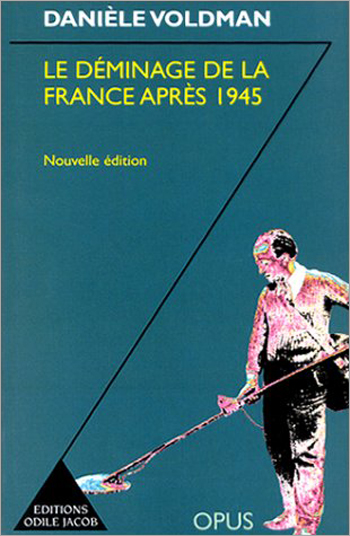
Danièle Voldman
The Mine Clearance of France after 1945
At the liberation of France, the country was covered in mines, planted by the Germans, the Allies and the Resistance during the conflict. The population were fearful of resuming normal life in the face of this danger: France had to remove the mines. Thus in 1945, mine clearance was invented, as before then no-one had any idea how to defuse these weapons of death! Who would be given the heavy responsibility of leading this task ? What did it involve ? What role did the German prisonners of war play ? Danièle Voldman, a historian, is the research director of the CNRS (Institute of Contemporary History).
Jean-Marie Bourre
The Dietetics of the Brain New Edition
How should we eat to think well and work productively? J.-M. Bourre, a neurotoxicologist, celebrates the pleasures of a greedy brain, a gastronomical brain. He takes us on a fascinating exploration of the complex chemistry which links our brain to our plate in the world of proteins, vitamins, mineral salts, and lipids. By providing the keys to proper nutrition, this book shows the way to greater mental awareness, energy, health and fulfilment, while respecting the real needs of both the body and the brain that most crucial organ. Throughout the book, pleasure (adapted to every budget) remains one of the authors main concerns.
Jean-Didier Vincent
The Biology of Passions (New Edition)
"A fascinating book, which demonstrates that the ensemble of the brain, neurons, and synapses is literally immersed in a chemical sea. We must rid ourselves of the notion that the brain is a supercomputer." Le Figaro
Michael S. Gazzaniga
The Social Brain
This book investigates the concepts of the "right brain" and the "left brain". According to the author the brain is most certainly made up of relatively autonomous modules which react independantly to environmental pressures. At least one of the modules, situated on the left side of the brain, is responsible for the interpretation of answers which may be contradictory with others, whereas yet another module on the same side translates into words the result of this interpretation. So, instead of being a unique, monolithic system that we imagined, the brain would appear to be a collectivity of systems - a social brain. This approach enlightens us as to the functioning of the human brain, and according to Gazzaniga, affects the very roots of our belief systems and societies. Renowned American neurologist, Michael Gazzaniga is Director of the Cognitive Neuroscience Division of Cornell University and chairman of Neuropsychology.