
Catalog All books
Alain Prochiantz
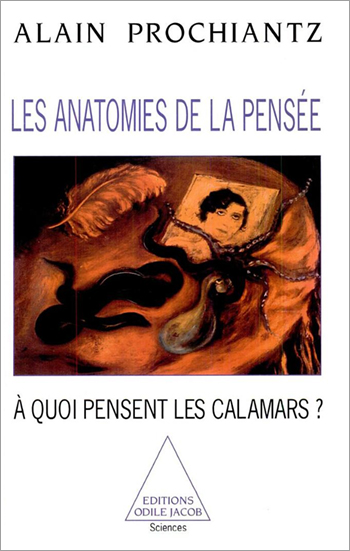
The Anatomies of Thought What do squid think about ?
When we watch a squid facing up to a predator, we see it recoil, agitate the tentacles, spray a jet of ink, and then make use of the temporary blindness of the predator in order to escape to a safe hiding place. Are we able to say what it is thinking ? Evidently, we know that this behaviour is not the result of a reflex unleashed by the sight of an enemy. The mollusc is not however conscious of its acts, at least not in the sense that we, as human beings, understand this term. It is true that we are the product of a evolution of species, and that, although this may not be welcome news for everyone, we share a common ancestry with the octopus, or even the fly. Even if the structure of our cortex, and the invention of language allows us to write about octopuses (or flies), and not the other way round, the fact remains that these evolutive roots, in the same way as other animal species, including invertebrates, have something to teach us about the nature of our thoughts. Alain Prochiantz
Alain Prochiantz
Darwin: 200 Years
More than an homage to a great scientist, this book, written by eminent specialists, is a perfect introduction to understanding the impact of Darwinism on contemporary thinking and science

John Scheid, Alain Prochiantz
Lights, light
The 2015 Colloquium of the Collège de France unites some of the most eminent authors in physics and astrophysics, in biology, in neuroscience and the history of science. Light is a timeless subject: it has always had the power to fascinate and disturb. Here it is explained.


Patrick Boucheron, Alain Prochiantz
Migrants, Refugees, and Exile Colloquium at the Collège de France
The timeliness of the issue of migratory movement and the displacement of populations. The multi-disciplinary nature of the studies, which bring together history and geography, geopolitics, psychology, as well as law and economics.
Ilya Prigogine
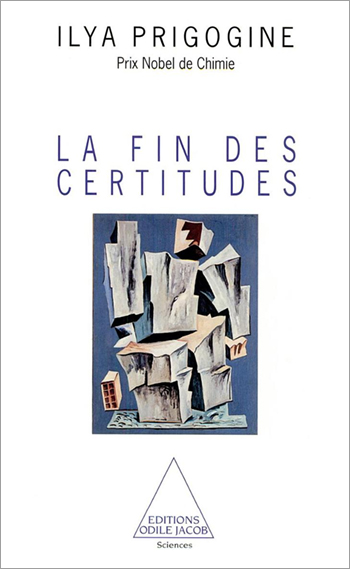
The End of Certainties
As we come to the end of the century, the question of the future of science is often posed. I believe we are just at the beginning of a new endeavour. We are witnessing the development of a science which is no longer limited to simplified, idealised situations, but makes us face the complexity of the real world. This new science will allow human creativity to be experienced as the unique expression of a fundamental trait common to all aspects of nature. Ive tried to present this conceptual transformation, which implies the beginning of a new chapter in the fruitful relations between physics and mathematics, in a manner that will be comprehensible and accessible to all readers interested in the evolution of our ideas of nature. We are but at the threshold of a new chapter in the history of our dialogue with nature, writes Ilya Prigogine. Ilya Prigogine, winner of the Nobel Prize for Chemistry, teaches at the Free University of Brussels and at the University of Texas, in Austin.


Ilya Prigogine
The End of Certainties (Coll. Opus)
As we come to the end of the century, the question of the future of science is often posed. I believe we are just at the beginning of a new endeavour. We are witnessing the development of a science which is no longer limited to simplified, idealised situations, but makes us face the complexity of the real world. This new science will allow human creativity to be experienced as the unique expression of a fundamental trait common to all aspects of nature. Ive tried to present this conceptual transformation, which implies the beginning of a new chapter in the fruitful relations between physics and mathematics, in a manner that will be comprehensible and accessible to all readers interested in the evolution of our ideas of nature. We are but at the threshold of a new chapter in the history of our dialogue with nature, writes Ilya Prigogine. Ilya Prigogine, winner of the Nobel Prize for Chemistry, teaches at the Free University of Brussels and at the University of Texas, in Austin.

Géraldyne Prévot-Gigant
The Power of an Encounter An encounter can change your life
A book that enables the reader to question him or herself about encounters, to understand their value, to find meaning and responses for better self-knowledge.

Géraldyne Prévot-Gigant
How to Find Love Preparing to Meet Someone New
Know yourself — and take a step toward a happier love life

Géraldyne Prévot-Gigant
The powers of hope
Hope, among the values of positive psychology, is fundamental. It is an indication of mental well-being. A profound reflection on hope presented in a very pedagogical style.