Catalog All books

Caroline Eliacheff
À corps et à cris How to psychoanalyse young children
Oliver, Zoe, Mathias and the others are children of grief. They barely speak. They have faced innumerable trials: unknown mothers, abandon, adoption, even separation from imprisoned parents. Traditional medicine allows them to survive, but cannot teach them to live. Is there a solution? This book attempts to reach these neglected children and, through words, to heal. Caroline Eliacheff is a psychoanalyst who counts among her published works Les Indomptables, written in conjunction with Ginette Raimbault.

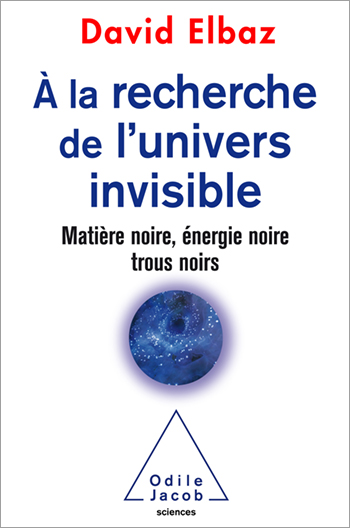
David Elbaz
Another Way of Looking at the Universe The art of seeing the invisible
An overview of the major issues in astrophysics and cosmology. “Dark” matter and energy are undetectable: either they don’t in fact exist, or we don’t know how to see them... Above and beyond the astrophysical phenomena themselves, this book offers epistemological reflections that are only rarely addressed.
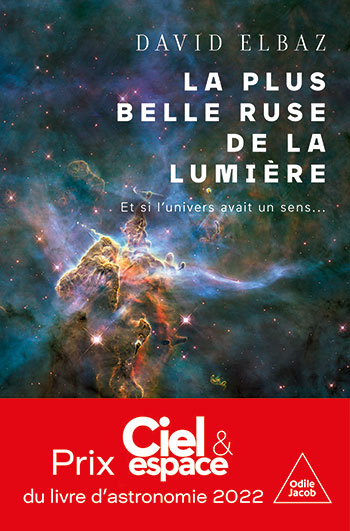
David Elbaz
The Greatest Trick of Light
The universe follows a direction, and that direction does not go toward ever more disorder, as is sometimes suggested.
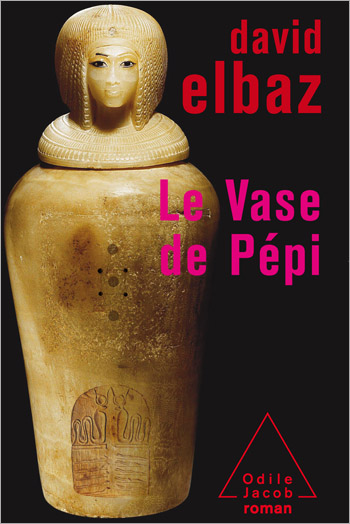
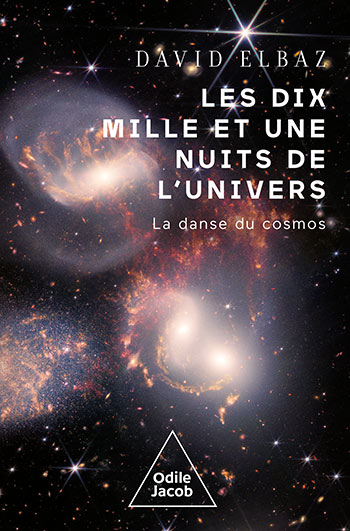
David Elbaz
The 10,001 Nights of the Universe The Dance of the Cosmos
A modern version of Arabian Nights about the latest discoveries of the universe

David Elbaz
and Alice Tao Remembered the Future
In his first novel, Le Vase de Pépi, David Elbaz blended quantum physics with Egyptian mythology to take us on a fascinating journey through time in the world of particles. The inspiration for his new novel is once again time-travel, but now his vivid physicist's imagination, always on the lookout for strange paradoxes, moves constantly back and forth between Ancient China and the future.
Ivar Ekeland
The Boiling Frog Syndrome
Climate change viewed by an economist. Will Homo economicus survive climate change? A step towards new way of thinking about the economy.

Ivar Ekeland, Jean-Charles Rochet
We Must Tax Financial Speculation Against widespread speculation – a universal tax
Financial speculation goes back to ancient times. Its history sheds light on many aspects of the current situation.
Alberto Eiguer
From Sexual Perversions to Moral Perversions Pleasure and Domination
What is perversion really about? What does a pervert seek? The world of perversions is not only a mirror world of physical pleasure, it also serves as a mechanism of power in a relationship which the pervert uses to impose his/her rule on another, by denying his/her existence. Does the pervert seek pleasure or power? Alberto Eiguer is a psychoanalyst specialising in family therapy.

Barry Eichengreen
Exorbitant Privilege The Rise and Fall of the Dollar and the Future of the International Monetary System
As the dollar keeps falling, and in the run-up to the G20 summit, what are the options to reform the international monetary system? Barry Eichengreen urges the creation of a multipolar system
Alain Ehrenberg
The Despondent Society
Will individualism ultimately turn against society and the individual?

Alain Ehrenberg
The Mechanics of Passions: The New Contemporary Individualism
The book’s very stimulating thesis: the twenty-first century will be the century of the brain and the neurosciences, which are already playing the role that psychoanalysis played in the twentieth century.
Alain Ehrenberg
Tired of Yourself Depression and Society
Examining the changes that have occurred since the 19th century in both psychiatry and society at large, this book shows how the internal collapse that is depression is the ultimate symbol of our culture of powerlessness. The depressed person cannot rise above the demands imposed on him or that he imposes on himself. He has no recourse but fatigue, inhibition, and indecision. But what does it mean to learn to be oneself? Is our society merely creating huge numbers of hypochondriacs? Can we any longer draw a line between the small unhappinesses and frustrations of daily life, and pathological suffering? Alain Ehrenberg is a sociologist.
David Edwards
The Laboratoire’s Manifesto
The present work is about a very special kind of laboratory, which he founded and where creators and society can use the language of culture to communicate and to discover a new springboard for innovation.
Stuart J. Edelstein
From genes to genomes
Rapid progress in the field of genetics is changing our lives in more ways than one. In order to understand these changes, Stuart Edelstein has approached each facet of the subject from three points of view: contemporary society and politics; technical developments; and basic research. By keeping to some fundamental points, this book will enable the lay reader to understand before judging the social implications of recent discoveries in biology. This is science with a civic sense. Stuart Edelstein teaches biochemistry at the University of Geneva.
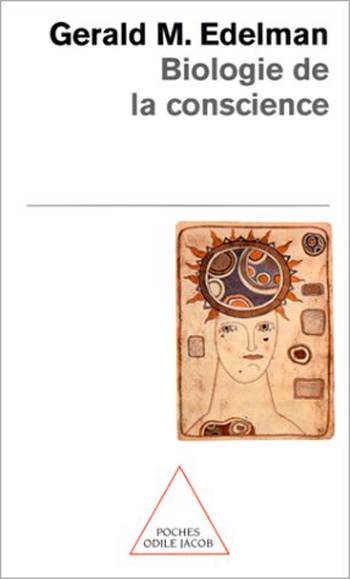
Gerald M. Edelman
The Biology of Consciousness
How do we think? What makes us beings that are endowed with conscience, capable of memory, of perceiving the surrounding world, of feeling passion? This book presents an ensemble of mechanisms that compose the human spirit and addresses the progress of the neuroscientific revolution: the biology of the brain and the study of its evolution are in the process of surrendering to us the key to conscience itself. Gerald. M. Edleman, winner of the Nobel Prize for medicine, heads the Institute of Neurosciences at La Jolla, California.

Marek Edelman
Unpublished Notebooks from the Warsaw Ghetto
A work enriched with many elements that clarify the text and enable it to enhance the previously known history of the Warsaw Ghetto.
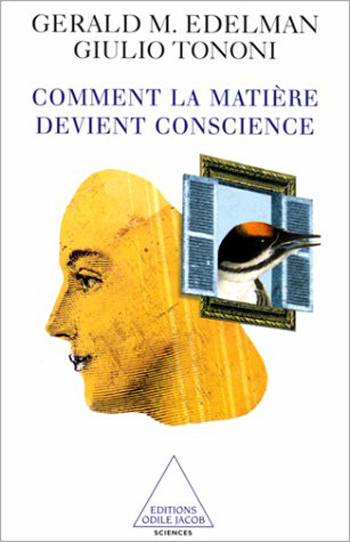
Gerald M. Edelman, Giulio Tononi
Consciousness : How Matter Becomes Imagination
How do the physical occurrences which take place in our brains create the world of conscious experience ? Philosophers have long disputed this question but today, it is science which is in a position to formulate real answers. Gerald M.Edelman and Giulio Tononi demonstrate that the processes which lead to consciousness are not confined to the brain, but are actually dependant on the functioning of numerous areas. They also show that these interactions are not fixed processes, but are constantly adjusted and modified. This research represents one step further towards understanding our identity and our complexity. Gerald M.Edelman, who has received the Nobel Prize for medicine, heads the Institute of Neurosciences at La Jolla in California. Giulio Tononi is a researcher at the Institute of Neurosciences.
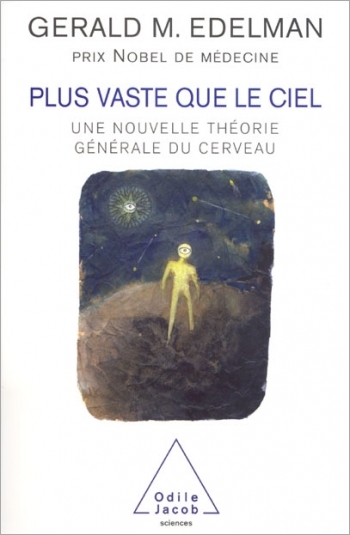
Gerald M. Edelman
Wider than the Sky
The brain is wider than the sky, For, put them side by side, The one the other will include With ease and you beside, wrote the American poet Emily Dickinson in the mid-nineteenth century. The fundamental mechanisms governing mental life are now the subject of scientific study. In this book, Gerald Edelman examines a major aspect of the mind - consciousness. How can the firing of neurons give rise to subjective sensations, thoughts and emotions? How can the disparate domains of mind and body be reconciled? A scientific explanation of consciousness must take into account the causal connections between these two domains. Such a theory must show how the neural bases of consciousness appeared during the evolutionary process and how certain animals developed consciousness. These are some of the key issues that Gerald Edelman examines here. He shows that consciousness cannot be located in a specific area of the brain, because it is a process linked to how the brain functions as a whole, to its wealth of connections and to its great complexity. The brain, he argues, is not a kind of computer. Edelman is regarded as one of the greatest theoreticians of the brain, and his notion of consciousness dominates all discussions on the subject among the international scientific community. This book offers the most accessible version of his theories that is available today. The winner of the 1972 Nobel Prize in Medicine, Gerald Edelman heads the Institute for Neurosciences, in La Jolla, California.

Maurice Duverger
Europe of Men
How is it possible to get many nations, separated by history, culture, political structures, to live together? If the European community functioned well with 6 members, in a mediocre way at 9, and at 12 members with difficulty, beyond, the E.E.C. will be ineffectual and paralyzed. One solution is available: to change the institutions. The author, a former member of the European Parliament, proposes here a new theory of federalism, the only way according to him, to progressively substitute to the power of the technocrats that of the members of Parliament and citizens.