
Catalog All books
Commission Canberra
Eliminating Nuclear Arms
"Legally, politically and strategically nuclear arms have been reduced to a tiny number of marginal hypotheses and will soon be mere anachronisms. They have lost their justification, their reason for being. But they continue to represent a danger for humanity : they could be used by accident or by mistake due to the mistaken interpretation of another country's attitude. We must therefore do everything in opur power to eliminate them once and for all." Michel Rocard
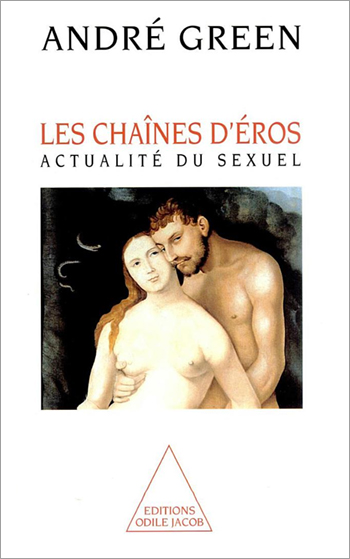
André Green
The Chain of Eros
Sexuality is no longer what it was when Freud elaborated his theory of its psychic functioning. His successors have either given it less importance or a completely different status. André Green has undertaken in this book a real re-founding. Sexuality, seen from a psychoanalistic point of view, is what he calls "an erotic chain", organized according to different steps (impulse, desire, fantasies, erotic language, etc.). For him, the importance it is not so much to consider each of these steps separately but to specify at which link of the chain the analyst himself stands. André Green, is a psychoanalyst and a psychiatrist.
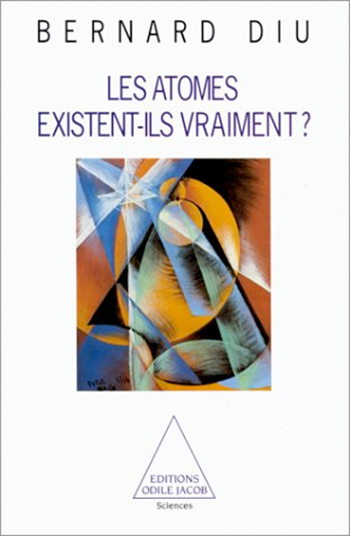
Bernard Diu
Do atoms really exist ?
Few scientific notions have aroused the speculative imagination like the thermodynamic entropy. All organised systems - societies, living creatures - are destined without exception to decline and eventual death. This book clearly exposes the historical and conceptual development of thermodynamics. Born from a desire to understand and master steam powered machines - the symbol of our industrialised societies - it became the science of the human body. However, it was suddenly passed over in favour of the theory of atoms. It was thus demolished by statistical mechanics which ceded to the imperatives dictated by the atomical structure of the body. After an epic struggle, sometimes quite ferocious, thermodynamics and statistical mechanics have been reconciled by adopting the base of the second with the techniques of the first. This book reads like a novel about contemporary physics. Bernard Diu, a graduate of the Ecole Normale Supérieur, is a professor at the University of Paris VII.
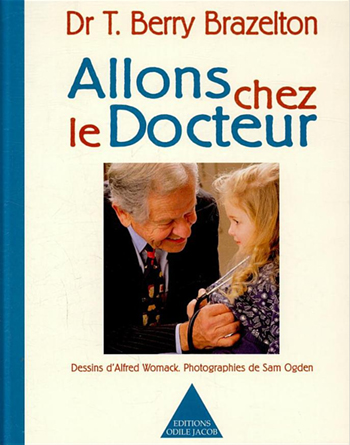
T. Berry Brazelton
Going to the Doctor
Written by one of the greatest American pediatriciens this book clearly explains to children the key moments of their medical visit. Through the choice of clear and interesting photographs, it awakens the natural curiosity of children, which is also raised by the often quite comical illustrations drawn by the author's nine year-old grandson. With this book, the former occasions of children's torments and parents' agony are transformed into a time of discovery and shared complicity. T. Berry Brazelton is an emerite professor at Harvard Medical School and has been a pediatricien for over forty years.
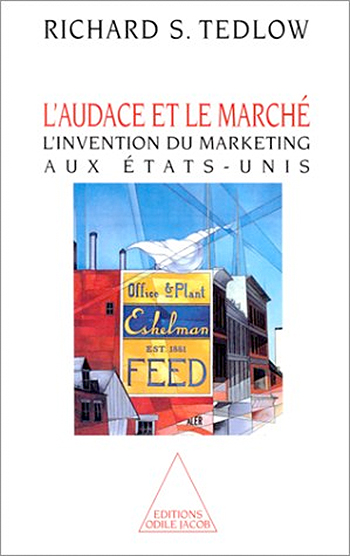
Richard S. Tedlow
Audacity and the Market The Invention of Marketing in the United States
What great commercial battles in the United States are at the origin of marketing ? What strategic choices, technologies and infrastuctures have made possible one of the great social and economic upheavals of the 20th century ? This book recounts the combats waged without mercy between Coca-Cola and Pepsi-Cola, and Ford and General Motors, and also the story of the pioneer manufacturers and distributors who created marketing, invented standardised products, international brands, the segmentation of markets, chains of shops and supermarkets... Richard Tedlow is a professor at Harvard Business School and has long been Editor-in-Chief of the famous Business History Review.
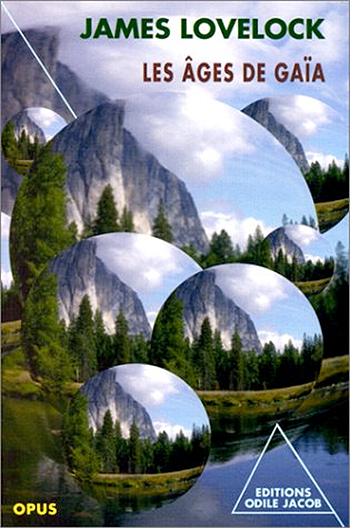
James Lovelock
The Ages of Gaia A Biography of Our Living Earth
The fascinating, controversial and most-worshipped hypothesis of ecologists - that of considering the Earth as the biggest living organism, referred to as Gaïa. It is here discussed by its inventor in person, who shows us that if our planet hasn't always had the same face, it's because there have been several ages corresponding to the predominance of very different species. In three centuries, humanity has wrought more modifications to the face of Gaïa than natural evolution did in millions of years. Although he does not doubt that the Earth, today turned completely upside-down by industrial activities, will find a new equilibrium, he does suppose that it could at the price of the disappearance of man, whose reign represents only one of the ages of Gaïa. Born in 1919, James Lovelock is the author of The Gaïa Hypothesis, a book which shook up the scientific world in the beginning of the seventies and met with great public acclaim.