Catalog All books

Claude Aron
Bisexuality and the Order of Nature
Our sex defines our identity before we are even named - "It's a boy" or "It's a girl" is the traditional welcome we receive in this world. Similarly, throughout our entire life, our gender defines our diverse social roles. Yet, this book shows how nature presents us with only one model, that of bisexuality. Endocrinian manipulations have shown that it is possible to change from one sexuality to another in a reversible manner. This book is key reading in the debate about the genetic character, or not, of homosexuality. Claude Aron, a specialist in in the physiology of reproduction, is also an honorary professor of the Louis-Pasteur University in Strasbourg.

André Miquel
Two Stories of Love (Work of the Collège de France) From Majnûn to Tristan
How does absolute passion express itself in Middle-Eastern and in Western societies?

François Godement
The Renaissance of Asia (New Edition)
How can the dynamism of modern Asia be explained ? Is there a unified Asian identity which could point to subsequent unification ? What is the role of the State, and the future of democracy in Asia ? François Godement presents one of the first major histories of the contemporary Far East in which he not only traces the recent history of the continent, but also reveals the future for occidental societies. François Godement is a professor at the Institute of Eastern Languages and head of research at the French Institute for International Relations.

Évelyne Pewzner
The Guilt of Man (Coll. Opus) Fault and Insanity in the West
Why is the obsessive horrified by a tiny stain ? Why does the depressive relentlessly search for a redemptive punishment ? When human behaviour translates the suffering and helplessness of an individual confronted with anguish and solitude to the collapse of that being, to a retreat inside a strange inner world, to the loss of all that which anchors him to life, it is not enough, in order to understand him, to connect up the events of his life. It is also necessary to situate that individual in the wider scale of cultural indictations, which play a determining role in the formation of the personality. In this way, Évelyne Pewzner undertakes to show in what sense, Western Christianity, which is intrinsically linked to the problem of evil, leaves in each of us an imprint of distress. Évelyne Pewzner is a psychiatrist, and a professor of psychopathology at the University of Picardie.
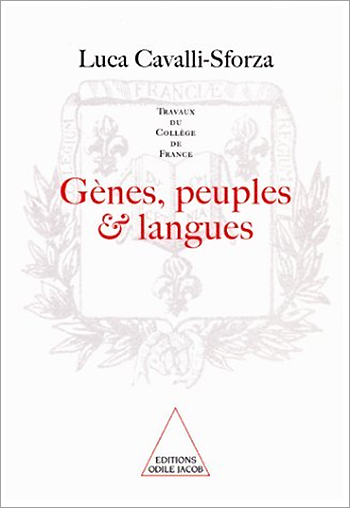
Luca Cavalli-Sforza
Genes, People and Languages (Work of the Collège de France)
How is culture passed on ? Is it possible to reconstruct the history of the evolution of the human species using genetic information from existing populations ?