
Catalog All books
Sylvie Cadolle
Being a Step-parent The Recomposition of the Family
More than one million children in France live permanently or occasionally with a step-parent. What place does a step-parent hold in the family of a child whose parents are divorced or separated? What role does he or she play? Is it sufficient to know how to love in order to succeed in reconstructing a family? This is the first French investigation into the relations between step-parents and step-children that allows both the adults and the children to freely express themselves. Sylvie Cadolle teaches philosophy and educational sociology.
Patrick Fridenson, Bénédicte Reynaud
France and the Age of Work (1814-2004)
In this history about working hours in France during the nineteenth and twentieth centuries, the authors present two highly original theses which go against some established ideas. Their first thesis is that the limitation or reduction of labour hours was not a political, social or economic issue but primarily a question of public health. The authors second thesis is that the movement for shorter hours was never a major demand of the trade unions since absenteeism served to regulate working hours but the policy of national and international institutions. This is a history book which responds to an impassioned issue in recent French political events. Patrick Fridenson is a historian. Bénédicte Reynaud is an economist.

Gustave-Nicolas Fischer
Mental Wounds The Strength to Start Over
This book is about the victims of psychological trauma: survivors of war atrocities, torture and attacks, as well as those men and women who suffer daily from emotional harassment. The author shows how these mental wounds can be cared for and how they can heal: by working on memory, through speech, through the support of therapy, by a gesture of reparation, and through forgiveness. Such is the healing process that will help victims to return to life and understand the price. Gustave-Nicolas Fischer teaches psychology and directs the laboratory of psychology at the University of Metz.

Daniel Widlöcher
How to Become a Psychoanalyst And Not Give Up
A master of psychoanalysis recounts how his career and his thinking made him who he is

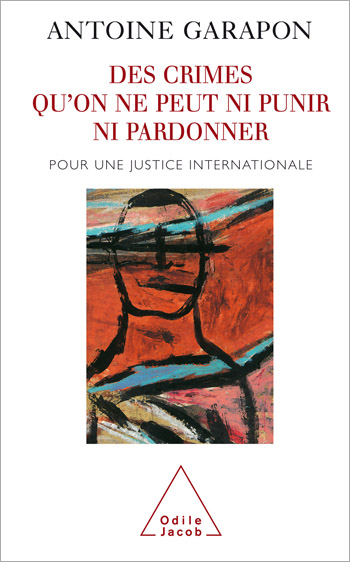
Antoine Garapon
Crimes Which Can Neither be Punished Nor Forgiven Towards an International Justice
The creation of a system of international criminal justice was one of the greatest political upheavals of recent decades. The fact that international criminal law has been allowed to question national sovereignty is a revolution in itself. The detractors of international justice contend that it is simply the justice of the victors. Could they be right? Have law and ethics been muddled? Have the trials conducted in its name helped heal the victims? Can justice prevent civil war? A former magistrate, Antoine Garapon heads the Institut des hautes études sur la justice.




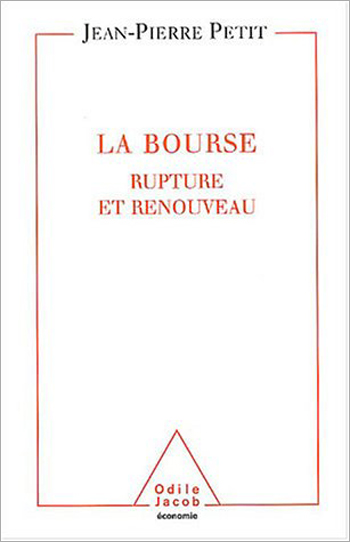
Jean-Pierre Petit
The Stock Exchange Renewal and Rupture
The current stock market crisis followed the period of fastest growth in world markets in history. How can this be explained? And what does it indicate for the future? While the bullish market that preceded the crisis was hyper-inflationist, we are now experiencing a period of deflation, a drop following on the heels of a vertiginous rise. In this respect, Petits interpretation is that of the regulationists: the crisis is one of confidence. He also describes how the crisis has revealed structural weaknesses in various countries. Jean-Pierre Petit is head of economic research for the investment company Exane.
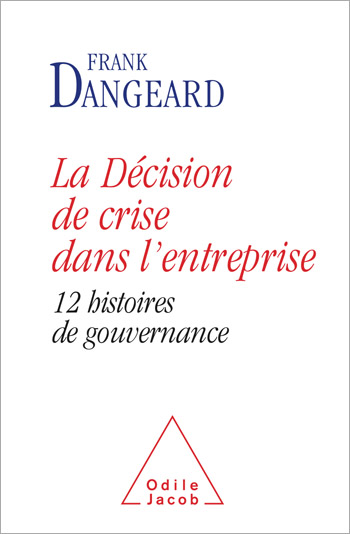
Frank Dangeard
Crisis Decision-Making in Businesses 12 Tales of Governance
Based on his extensive experience as a manager and administrator, and illustrated with numerous examples from recent business history...
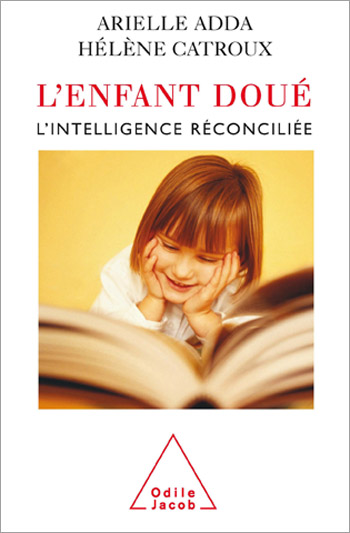
Arielle Adda, Hélène Catroux
The Gifted Child Reconciling Intelligence
Exceptionally gifted, gifted and intellectually precocious children make up as much as 5 % of any given age group. Yet they often seek failure, both at school and in their personal lives, because they suffer from being different from other children. This book is addressed to the parents and teachers of gifted children. Besides reviewing the current state of knowledge on the subject, it explains how such children can be taught to manage their potential and to overcome their excessive sensitivity and weaknesses. Arielle Adda is a psychologist. Hélène Catroux is an educational psychologist.
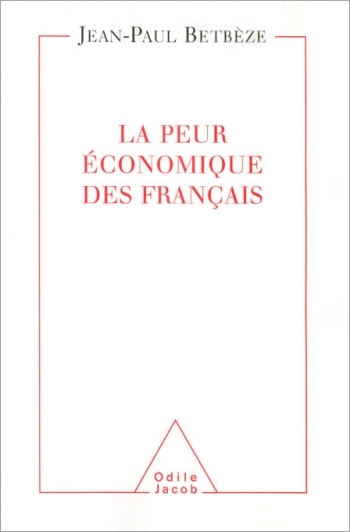
Jean-Paul Betbèze
French people's economic fear
France has economic possibilities, but it remains blocked in several areas. Although the country's leaders are aware of this, they seem unable to make the necessary reforms to move forward. France seems to be the prey of fears that paralyse it, but which have benefited a new class of economic as well as social rentiers who constitute a powerful economic, ideological and political group. These new rentiers are fully cognisant that the defence of their acquired privileges is not a practical long-term solution - as has been shown by rising deficits, decreased competitiveness and job losses. The author argues that it is necessary to make changes and implement reforms - and to do so it is essential to understand and overcome existing fears. It cannot be expected that everything will be changed at once, but some initial efforts must be made. The single reform that will fix everything does not exist, he says, but this is hardly an excuse for refusing to make a start. In other countries, programmes for economic reform are being implemented. Yet France is only beginning to consider such reforms. The object of this book is to provide a greater understanding of the present situation, in the form of a how-to manual. A ruthless analysis of some of France's psychological blocks, apprehensions and economic fears, this book can be regarded as a sort of economic psychotherapy. In addition, the author provides a critique of the false solutions that hinder modernisation and proposes his own solutions for change and reform. Jean-Paul Betbèze is a professor of economics at the University of Paris Panthéon-Assas and a member of the French prime minister's Council for Economic Analysis. He is a consultant to the president and the C.E.O. of a major bank and the author of Les Dix Commandements de la finance, which was awarded the Risques-Les Echos Prize in 2004.

Nicolas Mariot, Claire Zalc
Faced with persecution The Destruction of the Jews of Lens, 1940-1945
The history of the Holocaust in France, seen from an entirely new angle. This book does not simply describe the numerous possible attitudes: it aims to explain them.

Robert Boyer
General Theory of Capitalism is it possible?
Robert Boyer is a leading figure of the regulationist school of economics, which believes that capitalism requires external, political, monetary and social regulations, and that the capitalist economy cannot be reduced to the self-regulating laws of the market. In this book, he proposes a general theory of capitalism, from two angles. First of all, he argues that there are several models of capitalism - not just one. America's ultra-liberal capitalism is unlike German capitalism, which is characterised by the fusion between banks and businesses, just as it is unlike French state-interventionist capitalism and Japan's capitalism of consensus. Secondly, in order to understand how capitalism works, every aspect has to be considered - not just the market but also political and social institutions (the State, central banks, unions, etc.) and the conventions they create among themselves (salary agreements, etc.). Robert Boyer is a research fellow at the Centre National de la Recherche Scientifique, a director of studies at the Ecole des Haute Etudes en Sciences Sociales and a member of the French prime minister's Council for Economic Analysis.
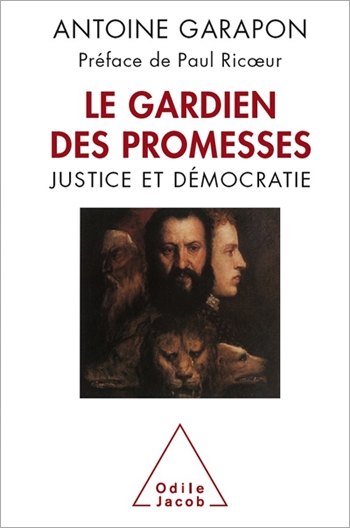
Antoine Garapon
The Guardian of Promises Justice and Democracy
The multiplying cases, the explosion of litigations, the sensational trials which catch the attention of the public : all are evidence of a growth in power of the judicial system, which we expect to be, at the same time, the arbiter of morals, the guarantee of public morality and responsible for the salvation of the people. But why dont we ask what things it cannot provide ? Isnt the idea of a judicial democracy just an illusion, which serves to hide serious problems ? The power of the judicial system is more worrying than exciting. It is an indicator of the discreditation of the State at the same time as a reduction in social cohesion. In the face of the fragility of democratic society, this book is a thorough reflection on the exercise of public power, affirming that the real role of the judge is not to take the place of the politic, but to diffuse the risk of democratic implosion by remaining the guardian of the promises at the very heart of republican laws. Antoine Garapon, a former judge and member of the editorial team of the journal Esprit, is the head of the Institute of Advanced Judicial Studies.
Dominique Reynié
Europeans in 2004
What does Europe's future hold? To answer this question, Dominique Reynié examines trends and developments in Europe's civil society, current events, and the debates and ideas currently under public discussion in the E.U. and in the rest of Europe. The information included here covers statistics and opinion polls; political events; political, economic and social issues; legal and constitutional questions; as well as European character traits, mind-sets and lifestyles. This is an indispensable work for anyone who wishes to become familiar with the reality of Europe in flux. Also included here is a unique synthesis of election results in all of Europe during the past year. Dominque Reynié teaches at the Institut d'Etudes Politiques, in Paris, and is the director of the Observatoire Interrégional du Politique. He is most notably the author of Le Triomphe de l'Opinion Publique.