
Catalog All books
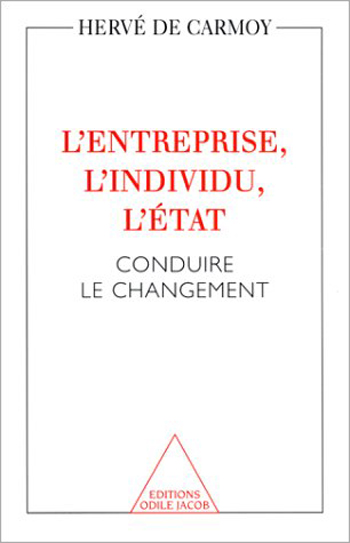
Hervé de Carmoy
Entreprise, Individual and State Leading to Change
The author believes that France is suffering from numerous ills, including inertia, demagogy, unemployment, corruption, corporotism, elitism, and a general withdrawal from the outside world. He also thinks that much more than clear-headedness and a desire for change are required if a cure is to be found. What is the best way of making the necessary changes? How have others gone about implementing those changes? He believes the business world provides an excellent model for learning how to deal with an ever-changing environment. Hervé de Carmoy was formerly general director of the Midland Bank in London.

Régis Debray
Believe, See, Do Crossings
In this work, Régis Debray gives free rein to his thoughts and tackles the varied subject matter provided by daily events encountered " in the news, out of the blue, or through friendship or surprise, at a moments notice and without great forethought. " The subjects he writes about range from " the Gulf War to a photo exhibit, from Tatis Jour de Fête to copyright registration, from a daydream about water to a meditation on road travel. " Other works by Régis Debray published by Editions Odile Jacob include Que Vive la République!, Tous Azimuts, and Transmettre.




René Soulayrol
The Stricken Child Understanding the epileptic child
Do epileptic seizures occur completely out of the blue? Or is there an underlying cause? How do epileptic children live with their bodies on a day-to-day basis? Can epilepsy result in the impairment of the childs intelligence? What are the links between epilepsy and neuroses or psychoses? This book springs from an attempt to understand the psychological behaviour of the epileptic child, and the efforts that the child must make in order to adapt and continue to live as normal a life as possible, in spite of the disease. René Soulayrol teaches child psychology in the Faculté de Medécine, in Marseille.

Danièle Voldman
The Mine Clearance of France after 1945
At the liberation of France, the country was covered in mines, planted by the Germans, the Allies and the Resistance during the conflict. The population were fearful of resuming normal life in the face of this danger: France had to remove the mines. Thus in 1945, mine clearance was invented, as before then no-one had any idea how to defuse these weapons of death! Who would be given the heavy responsibility of leading this task ? What did it involve ? What role did the German prisonners of war play ? Danièle Voldman, a historian, is the research director of the CNRS (Institute of Contemporary History).

Joseph Rovan
Bismarck, Germany, and a United Europe 1898-1998-2098
1898-1998: the difference between these two dates is vast, and it is likely that the difference between 1989 and 2098 will be even sharper. This gives us even more reason to reflect on the actions of a man who was able to anticipate and incite change. Joseph Rovan has taught German studies at the French universities of Vincennes and Paris-III. He is the author of many books and articles, including France-Allemagne: Le Bond en Avant, with Jacques Delors and Karl Lamers, published by Editions Odile Jacob.