Catalog All books

Jean Piaget
Of Education
What is the teacher's role and how important is it in a child's education? Should this role include the shaping in the child's mind of the tools with which to grasp and comprehend the world? How should activities be presented so as to be easily understood by children? What are the difficulties that children encounter when resolving mathematical problems? Pedagogical methodology, the role of the educator, and the child's autonomy : these are some of the subjects that Piaget reflected on throughout his life and which remain central to educational concerns today.
Anita Phillips
A Defence of Masochism
Running a marathon, harbouring the fantasy of being raped, eating a painfully spicy meal in an Indian restaurant writing a university thesis, feeling constantly overcome with a desire to be altruistic, happily allowing a woman wearing sharp heels to tread on your chest, being passionately in love with someone who isnt even aware that you exist, swimming in the North sea at the end of November" Writer, editor and animator for a literary publication, Anita Phillips gives art classes in several English universities.
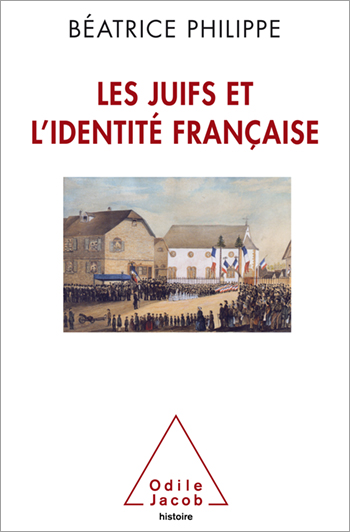
Béatrice Philippe
The Jews and French Identity
How Jews in France successfully integrated without denying their identity
Edmund Phelps
Mass Prosperity
A profound reflection, at the meeting-point of economics and psychology, on the forces of innovation and economic well-being and the motivations of both. A view of innovation that confronts many accepted ideas — the Schumpeterian view of the entrepreneur, the development of science as a source of innovation, and so on — and which needs to be debated.
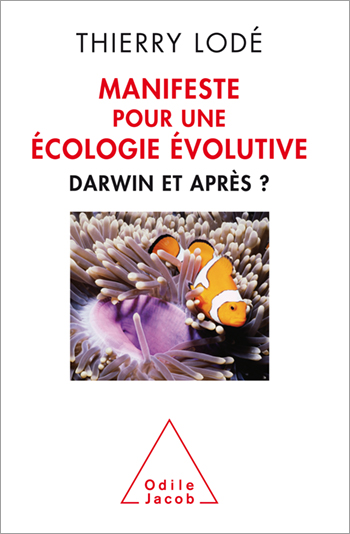
Philippe Miné, Jean-Pierre Pharabod
Fascinating Quantum Field Theory
A fascinating, informed work that takes us to the heart of the quantum revolution
Jean-Pierre Pharabod, Gérard Klein
Fortune and Misfortune in Quantum Physics (Re)discovering the great theories of physics
The great theories of physics seen through the controversies they provoke. Quantum physics and general relativity, the two pillars of modern physics, are a source of fascination to many. Difficult subjects tackled in their historical context and without scientific tools.
Jean-Pierre Pharabod
UFWs Unidentified Flying Weapons
Most reported sightings of UFOs turn out to be errors, optical illusions, hallucinations, and even practical jokes. But five per cent of all reported cases are more difficult to dismiss. According to the author, the unidentified objects may be clandestine terrestrial aircraft prototypes or secret weapons launched by the major industrialised nations, particularly the United States. Should the mysterious sightings be attributed to UFOs or to UFWs (Unidentified Flying Weapons)?
Alain Peyrefitte
The Economic "Miracle"
The 20th century has been marked by the growing awareness of the unbearable gap between developed and under-developed countries. And the most outstanding fact of the next century will probably be the worsening in this imbalance. In order to find a solution to the under-development scandal, Alain Peyrefitte attempts to understand the miracle of development. He examines the successive miracles which have allowed a part of humanity to pull through the turns of dictatorship or anarchism, violence and destitution.
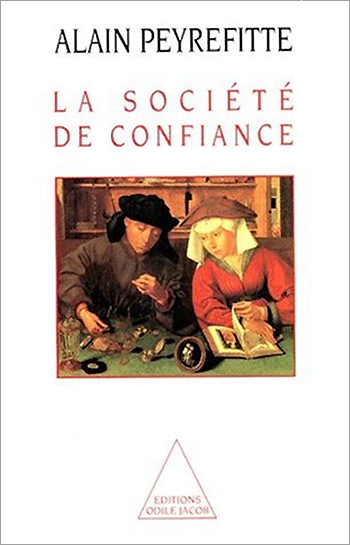
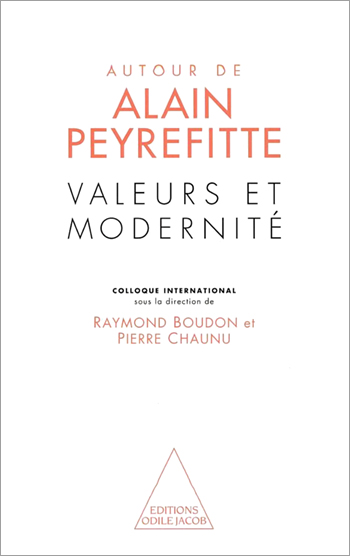
Alain Peyrefitte, Raymond Boudon, Pierre Chaunu
Values and Modernity Expanding on Alain Peyrefitte
With The Society of Confidence, and Of the Economic Miracle, Alain Peyrefitte has illustrated that growth is not primarily founded on the material wealth of a nation, capital, or even on work. Development is intrinsically linked to mentalities and values, which are the essential elements of economic, political and social modernity. Using this thesis as a starting point, the Institute of France organised a conference which brought together economic and technological historians, sociologists, criminologists, and experts from across the world, amongst which were R.Boudon, S.Eisenstadt, D.Landes, and S.Lipset. The wide spectrum of debate runs from the history of religious mentalities (P. Chaunu, J.Delumeau), to penal philosophy (D. Szabo). The comparative outlook of this book allows the reader an insight into the hidden depths of confidence, from Switzerland (J.-F. Bergier), to Japan (Terushi Hara), right through to the Third World (P. Moussa).