Catalog All books
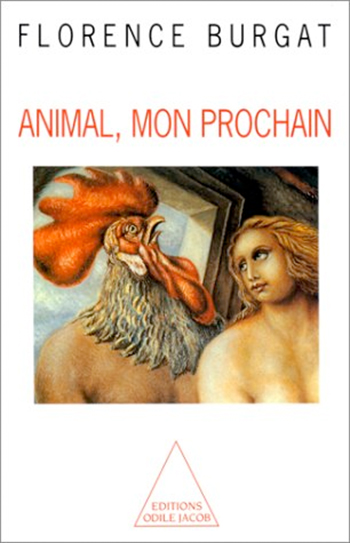
Florence Burgat
The Animal, My Relation
On one hand, men exploit, manipulate and slaughter animals. On the other hand, they let animals interfere with their lives, pollute them, and sometimes dominate them. Since the classical Age, Man has sought to define himself in his opposition to animals. Claiming for himself the most noble faculties - consciousness, thought, esthetic sense, morality - he represses his own animal side, notably his sexuality. But Florence Burgat goes beyond this negative statement. She walks in Jean-Jacques Rousseau's steps, claiming that men, like animals are sensitive beings, liable to suffer. On this basis, she proposes a new morality. Florence Burgat is a philosopher, and works at the Laboratory of Social Anthropology of the College of France.

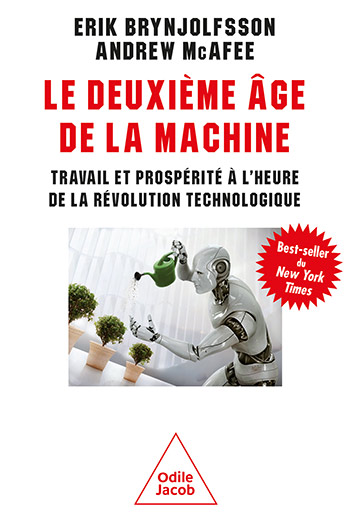
Erik Brynjolfsson, Andrew McAfee
The Second Machine Age Work, Progress, and Prosperity in a Time of Brilliant Technologies
A fundamentally optimistic book, The Second Machine Age will alter how we think about issues of technological, societal, and economic progress.
Erik Brynjolfsson, Andrew McAfee
Machine, Platform, Crowd: Harnessing Our Digital Future
How does the digital revolution enable a new integration between the human mind and machines?
Raymond Bruyer
The Brain that "Sees"
Based on numerous examples, this book describes and explains the phenomenon of perceptive recognition: how with minimal information the human brain can identify not only general forms (a man, a woman, a cat, a dog, a house, and so forth), but also specific individuals who might seem scarcely distinguishable from one another, unless a large amount of information is provided. This study of the brain that sees is also an exploration of the perceived world. Raymond Bruyer teaches experimental psychology at the University of Louvain La Neuve, Belgium.
Claude-Paul Bruter
Understand Maths The 10 Fundamental Principles
What does the world look like from a mathematical perspective ? This is what Claude-Paul Bruter explains through the fundamental principles of the discipline, from the theorem of Thalès to differential forms. He explores the notions of vector and space curvature, the implicit function theorem, and the characteristic of Euler-Poincaré, the different geometries and topological surfaces. Written in part for students, this work is accessible to all those interested in mathematics. Claude-Paul Bruter is a professor at the University of Créteil