
Catalog All books
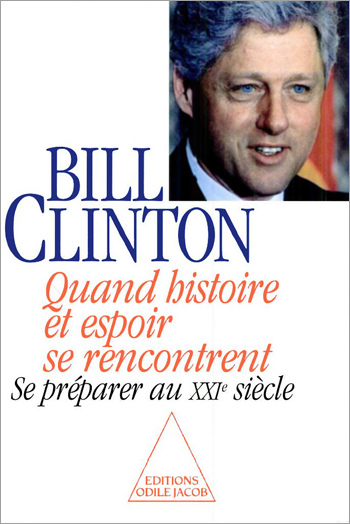
Bill Clinton
Between Hope and History Meeting America's Challenges for the 21st Century
For many people, America remains a model. A model of an economy in full growth, a model of a society which has created millions of jobs, a model of a nation reuniting men and women from the most diverse origins. Today, like before, America demonstrates her amazing capacity to adapt and to bounce right back. For the first time in print, the President of the United States expounds his personal vision of the American dream, a dream which he intends, from this moment forward, to transform into reality. A political document, but also offering many subjects, from education to budgetary concerns, for general reflection.
Willy Pasini
What use do couples serve ?
What use do couples serve? How can a solid couple be distinguished from a fragile one? Is 'living together' preferable to marriage? How can a healthy balance be maintained between intimacy and autonomy? How can passion be made to last? Can shaky bonds be salvaged? When should a therapist be consulted and how can the most suitable therapy for a specific case be chosen? At a time when the couple as a unit is undergoing a severe crisis, this book demonstrates that if every love story carries with it a risk, happiness within the couple is nevertheless possible. Willy Pasini is the founder of the European Federation of Sexology. He teaches psychiatry and medical psychology at the University of Geneva.
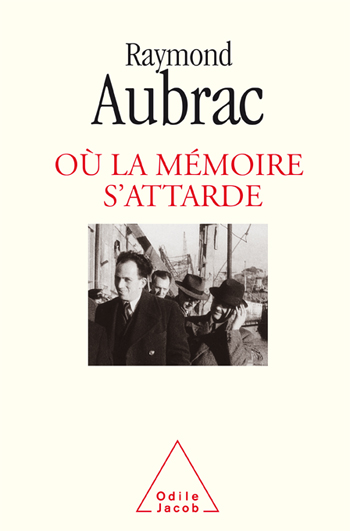
Raymond Aubrac
Where the memory lingers
Discreet by nature and secretive by necessity, Raymond Aubrac has been closely involved in more than half a century of history, in France and abroad. Within France, he is one of the great figures of the Resistance, and is one of the last survivors of the meeting at Caluire, on June 21st 1943, in the course of which Jean Moulin was arrested. A confidant of Ho Chi Minh, Raymond Aubrac also played a central role in the secret negotiations which accompanied the Vietnam war. In this book he gives a new, personal account of these events and others, including his meeting with de Gaulle, his role in the reconstruction of France, and his work at the heart of the UN.


Françoise Héritier
On Violence A Seminar
How can violence can be put in the service of religion ? What political gains can be made from cruelty ? How does a belief system encompassing hatred end in the massacre of entire populations ? Through reflections on, amongst other things, the Bible, Muslim law, the situation in Colombia, the ethnic cleansing in the former Yugoslavia and the genocide of the Rwandan Tutsi, this book, the product of a seminar organised at the Collège de France by Françoise Héritier in 1995, benefits from a multi-disciplined approach in order to identify and understand a phenomenon which has occasionally plunged societies into a destructive frenzy. Françoise Héritier is a professor at the Collège de France where she heads the Laboratory of Social Anthropology.
Harlan Lane
When the Mind Hears (Coll. Opus) A History of the Deaf
This historical work recounts the struggle of deaf-mutes against prejudice, so that their rights and their language, sign language, were recognised. The people figuring in this book run from the abbey de l'Épée to Laurent Clerc, the spokesman for this community in the United States. A linguist, psychologist, and specialist in sign language, Harlan Lane teaches in Boston. He is the author of The Wild Child of Aveyron, which inspired the famous film by François Truffaut.