
Catalog All books
Jacques Cantier, Éric Jennings
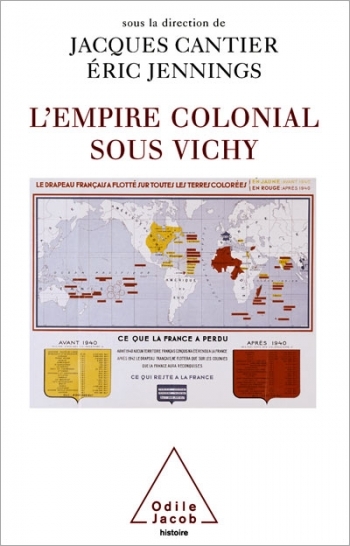
The French Colonial Empire under Vichy
In the 1990s, historians began studying the Vichy government in the French colonial empire. The articles gathered here by Jacques Cantier and Eric Jennings are the outcome of recent exchanges among historians on the subject. The book reflects the writers' various research interests and includes: an examination of the political decision-making process, the composition of governing bodies, the development of institutions to strengthen government control of society, and the reaction of the local population to the new political measures. The editors' purpose is dual. First of all, the colonial mirror serves to elucidate the underlying logic and the workings of the regime that resulted from the French defeat. Secondly, the editors have sought to place the Vichy period into the wider context and more extended time frame of colonial history and decolonisation. They have done this by structuring their analysis of Vichy in the empire into several sections. The first part of the book examines the conditions under which the Vichy government tried to unite the colonial bloc to mainland France. The second part analyses Vichy's authoritarian policies, particularly those that aimed at controlling youth. The large demonstrations that took place in Vichy Algeria in 1941 illustrate the efforts undertaken to showcase the National Revolution in Algeria. The third part studies the different forms of repression exercised by the regime, particularly the conditions governing the application of anti-Semitic legislation in the empire, the stifling of the Masons, and the existence of internment camps in North Africa. The fourth part reveals the tactics used by the European and colonial elites in French West Africa (Afrique Occidentale Française) to preserve their influence. The Vichy legacy is examined in a final section, which provides both an overview of the situation in the empire as a whole and a detailed analysis of the telling example of Madagascar. This is a unique and highly innovative study by eminent historians of a little-known aspect of French colonial history during the Vichy period. Jacques Cantier is a lecturer at the University of Toulouse-Le-Mirail, France. He is the author of L'Algérie sous le régime de Vichy and Jules Roy: l'Honneur d'un rebelle. Eric Jennings is an assistant professor at the University of Toronto, Canada. He is the author of Vichy in the Tropics.

Janine Mossuz-Lavau
The French and Politics An Investigation of a Crisis
Are the French really discouraged and depoliticized? Janine Mossuz-Lavau decided to go into the field, to interview the people and give them a voice. What are they suffering from? What do they want? What do they believe in? These are the questions that she attempts to answer after having questioned men and women of all ages and social backgrounds, from all regions and personal affinities. Political analyst Janine Mossuz-Lavau is a Research Director at CNRS and the National Foundation of Political Science.
Michel Godet
Freeing the Job Market
Unemployment in France can be brought down to 5%. Michel Godet’s method shows how to ‘free the job market’
Alain Berthoz, Carlo Ossola
The Freedoms of the Improbable
A dozen high-level international researchers for a multidisciplinary approach to the improbable, a powerful factor of creativity in between the possible and the impossible.
Jacques Bouveresse, Daniel Roche
Freedom Through Knowledge: Pierre Bourdieu, 1930-2002 (Travaux du Collège de France)
Gathered in this volume are the texts of lectures given in memory of Pierre Bourdieu at an international colloquium held on 26-27 June 2003 and jointly organised by the Collège de France and the Ecole Normale Supérieure, with the backing of the Hugot Foundation.
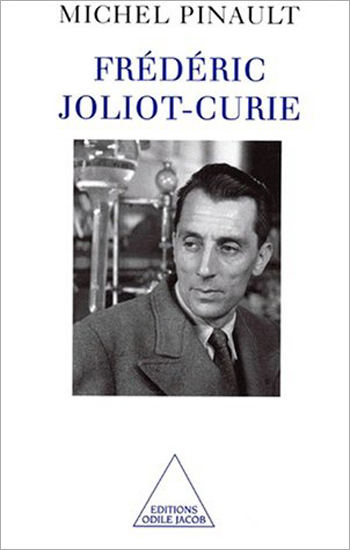
Michel Pinault
Frédéric Joliot-Curie
This is the first biography of Frédéric Joliot-Curie, the founder of French nuclear research and winner of the Nobel Prize for Chemistry in 1935. For many, he represents the political commitment of French intellectuals in the struggle against Fascism in the twentieth century. His life illustrates the transition from traditional science, limited to the world of academia, to Big Science, with major national and international repercussions. Michel Pinault holds an agrégation and a doctorate in history from the University of Paris I.
Karine Berger, Valérie Rabault
France Strikes Back For a More Competitive France
How can France recover its status as one of the world’s five most competitive nations?
Christian Sautter
France Reflected in Japan Growth or Decline
Where does the formidable Japanese resistance to unemployment come from? How can their persistence be explained when Japan, like all developed countries, is faced with robotization, technological revolutions and, more recently, competition in the form of young populations in neighboring countries? This should give France pause for thought: as starkly contrasted as these two cultures may seem, France and Japan are sister countries. Thus reflected in the mirror of Japan, France can discover that its decline need not be fatal, and that it is up to France to break with a decrepit conservatism and embrace growth. Christian Sautter is the director of studies at the Ecole des hautes etudes en sciences sociales (EHESS).
Jean-Baptiste de Foucauld, Robert Fraisse
The France of the Future
What will France be like in twenty years ? Faced with the fear of the future, with the current unease and confusion of French citizens, we need to change the way we look at things. We must stop asking ourselves about individualism in our society and look for answers to the mounting solitude. Stop theorizing about immigration problems and find the keys to demographic evolution. Stop fearing the invasion of the immaterial and start looking for the the new social fabric of tomorrow. We must suggest some possible plans of action and thought processes, provide some sketches of tomorrow's France, among the risks and hopes, to get some new perspectives.
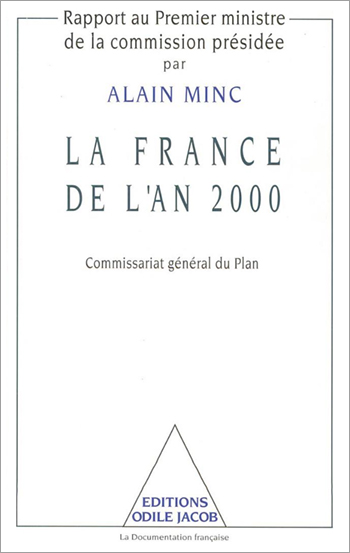
Alain Minc
France in the Year 2000
What are the biggest challenges of the year 2000? What great economic and social actions will France have to take in the years to come? The answer: assuring growth without inflation capable of favoring employment; making the state-providence more efficient, and adapting its productive system to the internationalization of trade. Edouard Balladur asked Alain Minc to address these key problems of French society and this work, an instant classic, will provoke reflection from a wide array of different personalities. A co-publication with La Documentation Francaise.

Jean-François Sirinelli
France in an Age of Major Upheaval 1962-2017
A look at France’s recent history by an historian attempting to define a consistent theme and perhaps also paint a picture of what the future may have in store.
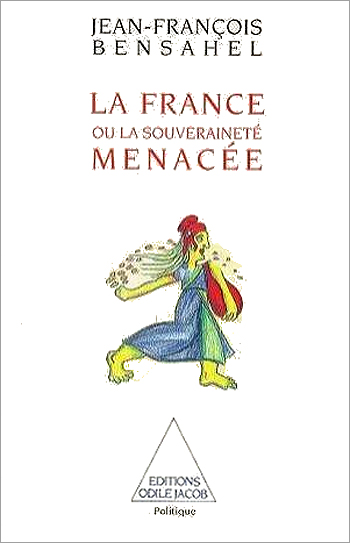
Jean-François Bensahel
France and Threatened Sovereignty
What may one hope for from a united Europe? What will be the future of France? Discouraging of both European illusions and those myths of the 1980s, the money-king and the triumphant individual, this work provides an indispensable reflection on how to tackle the difficult years ahead, to avert the explosive risks that weigh heavily on society and restrict the actions of the French State. Jean-François Bensahel, an ex-student of L'Ecole Normale Superior and the Ecole de Mines, holds a graduate degree in mathematics and is a high-level functionary.
Thierry deMontbrial, Thomas Gomart
France and the National Interest Is France’s foreign policy still guided by our own interests?
Fundamental to the upcoming presidential elections in the context of war in the Middle East and Africa, and of domestic insecurity. The book will be supported and promoted by the IFRI (Institut français de relations internationales).
Patrick Fridenson, Bénédicte Reynaud
France and the Age of Work (1814-2004)
In this history about working hours in France during the nineteenth and twentieth centuries, the authors present two highly original theses which go against some established ideas. Their first thesis is that the limitation or reduction of labour hours was not a political, social or economic issue but primarily a question of public health. The authors second thesis is that the movement for shorter hours was never a major demand of the trade unions since absenteeism served to regulate working hours but the policy of national and international institutions. This is a history book which responds to an impassioned issue in recent French political events. Patrick Fridenson is a historian. Bénédicte Reynaud is an economist.

Jacques Delors
France and Germany - the Leap Forward
"During the past fifty years, the Franco-German ship has been shaken by numerous storms--although they never seriously halted her forward movement. In our opinion, strengthening the friendship between our two countries and working towards European political union will not lead to the loss of our French and German identities, nor will it dampen their vitality, for there can be no great design unless our national communities are fully alive and strengthened by a sense of social and citizens' cohesion." Jacques Delors
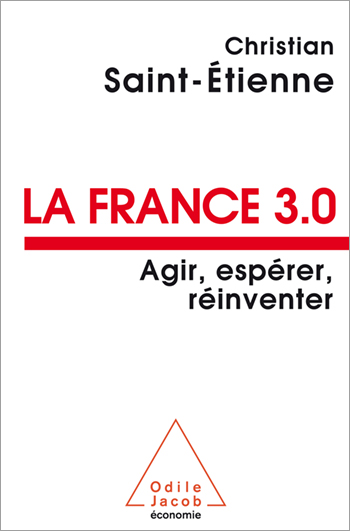
Christian Saint-Étienne
France 3.0 React, Renew, Reinvent
If French recovery is to succeed economic reforms must go hand-in-hand with political reforms
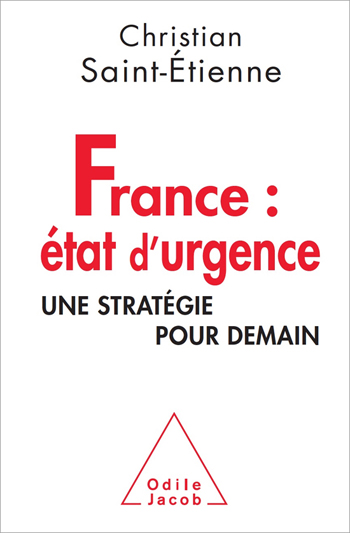
Christian Saint-Étienne
France : emergency A strategy for tomorrow
The Real Solution to Exit the Economic Crisis

Ludovic Orlando
Fossil DNA, a Time Machine
DNA sequencing isn’t of use only to doctors and biologists. It has become an essential tool for paleontologists and archeologists: for it is a true time machine.
Jacques Montangero
Forty Questions About Dreams
A wealth of information to understand and analyse dreams
Jean-Pierre Pharabod, Gérard Klein
Fortune and Misfortune in Quantum Physics (Re)discovering the great theories of physics
The great theories of physics seen through the controversies they provoke. Quantum physics and general relativity, the two pillars of modern physics, are a source of fascination to many. Difficult subjects tackled in their historical context and without scientific tools.