Results for the series Opus
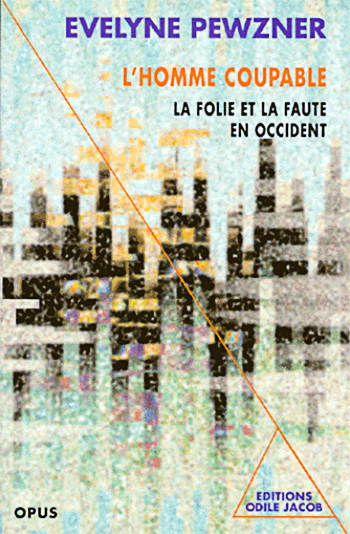
Évelyne Pewzner
The Guilt of Man (Coll. Opus) Fault and Insanity in the West
Why is the obsessive horrified by a tiny stain ? Why does the depressive relentlessly search for a redemptive punishment ? When human behaviour translates the suffering and helplessness of an individual confronted with anguish and solitude to the collapse of that being, to a retreat inside a strange inner world, to the loss of all that which anchors him to life, it is not enough, in order to understand him, to connect up the events of his life. It is also necessary to situate that individual in the wider scale of cultural indictations, which play a determining role in the formation of the personality. In this way, Évelyne Pewzner undertakes to show in what sense, Western Christianity, which is intrinsically linked to the problem of evil, leaves in each of us an imprint of distress. Évelyne Pewzner is a psychiatrist, and a professor of psychopathology at the University of Picardie.
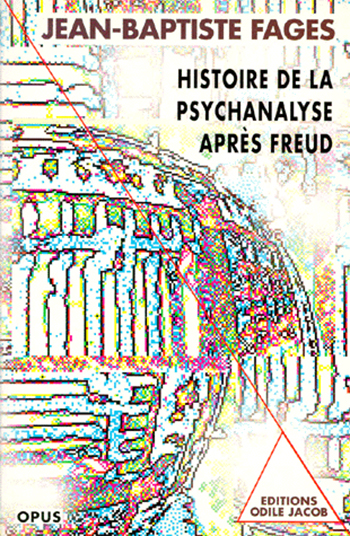
Jean-Baptiste Fages
History of Psychoanalysis after Freud (New Edition)
For all those who want an introduction in simple terms to psychoanalytical thinking this book highlights the great post-Freudian figures and principal movements. It examines in their turn the individuals who have made remarkable contributions (such as Sandor Ferenczi), those who were leaders and their spheres of influence (Adler, Jung, Lacan), the personalities united by their research area (for example the child psychoanalysis of Anna Freud and Mélanie Klein) or by cultural convergence (such as the New York School, the cultural tendency, etc.). Sociologist, and doctor of the history of philosophy, Jean-Baptiste Fages teaches at the Sorbonne in the capacity of CELSA.
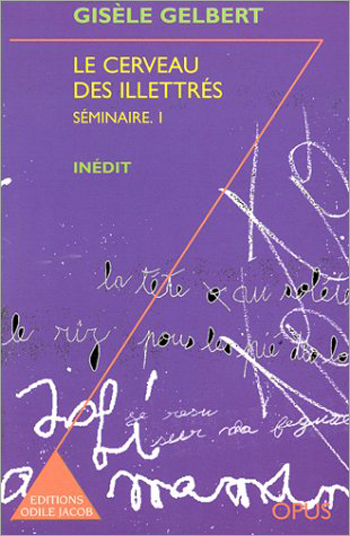
Gisèle Gelbert
The Illiterate Brain
Is illiteracy a social scourge, or is it an aphasia-like disorder? To find the answer, Gisèle Gelbert delves into the mysteries of the brain of an illiterate person, and teaches us the art of `repairing' it. By thoroughly breaking down each linguistic act, she is able to define and localise with great accuracy the disorders observed in both written and oral expression. She also makes use of the schema to develop exercices that are especially adapted to the clinical observation of localised disorders, thus opening the door to new therapeutic possiblilities. Gisèle Gelbert is a neurologist and aphasiologist. She is the author of "Lire c'est vivre "(Opus, 1996) and "Lire c'est aussi écrire" (1998).