
Catalog All books

Serge Renaud
A Healthy Diet
It is possible to eat in a manner that reconciles the demands of staying slim, good health, and general well being - although the steady stream of unhealthy and sometimes dangerous slimming diets would tend to make us believe otherwise. The new health diet proposed here draws much from traditional Cretan eating habits - which seem to be responsible for the populations tenaciously long life. Crete has the highest life-expectancy rate, and its people have the lowest incidence in the western world of cardiovascular diseases, that scourge of the industrialised nations. Serge Renaud is the scientist who discovered that wine can play a role in protecting against cardiovascular diseases - a finding that has become known as the French paradox. After spending much of his career in the United States, he directed a research unit of INSERM (France) for twenty years.

Nathalie Zajde
The Children of the Survivors (New Edition) The Transmission of Trauma to Jewish Children
"I have terrible nightmares and I would like to know if other children of survivors have the same dreams as me. I think it is crazy to have never lived through the war, yet have these extremely precise dreams." In Jewish families, why do the children of those who escaped Nazi extermination often have the same dreams as their parents, even though their parents have never spoke about the traumas which they lived through ? Reinforced by cleverly recounted stories, this book describes precisely what is called the survivors syndrome, an illness which manifests itself through nightmares, feelings of intense terror and desertion, a particular and incurable annoyance, recurring memories, and unfounded fears. It demonstrates that, thanks to the techniques of ethno- psychiatry, it is possible for these children of survivors to take back their place among the living. Clinical psychologist, and master of conference at the University Paris VIII, Nathalie Zajde is also a researcher at the Georges Devereux Centre.

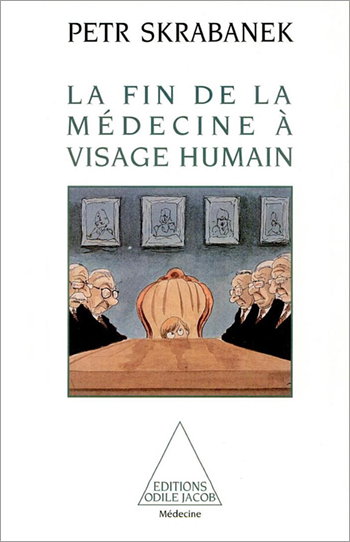
Petr Skrabanek
The End of Humanitarian Medicine
Medicine is at a crossroads. Traditionally, practitioners helped patients who came to them looking for support, for something to alleviate their suffering. However, the progress which has been accomplished in the last few decades has changed everything. Doctors now claim to be fighting death itself, they believe medicine to have almost limitless powers, and they try to prevent illness by changing behaviour. From this point onwards, our entire existence becomes overmedicalized. In the name of health at any price, doctors now dictate, prescribe and legislate whilst forgetting the essential meaning of their job : to help and to care. A violent criticism of contemporary medicine.
Robert Darnton
Mesmerism and the End of the Enlightenment in France
At the beginning of 1778, Franz-Anton Mesmer arrived in Paris where he set about expounding his rather exotic theory - that the universe was swimming in a fluid which was responsible for occurences such heat, light, electricity and magnetism, but it was this fluid's relevance to medicine which he wished to highlight. In order to restablish health and man's harmony with nature he undertook strange healing sessions which became the origins of an extraordinary craze. Quickly, mesmerism became a disguised political theory. In demonstrating the links of mesmerism to politics, and the scientific notions of the age, Robert Darnton provides in this work a decisive contribution to the study of the diffusion of ideas in French society at the end of the 18th century. Robert Darnton is a professor at the University of Princeton
Norbert Rouland
The French State and Pluralism A Political History of Public Institutions from 476 to 1792
Has France become a multicultural society? Are we heading towards a dislocation of French unity, or a more advanced form of democratic life due to this pluralism? Can we invoke the French tradition which has given us several reference points? These are the serious questions which History must confront, and it is the aim of this history of public institutions to do just that. The author shows that the French State has constructed the Nation through a stronger voluntarist policy than found in most other Western European countries. His clear yet detailed style makes this book accessible to a wide readership, both those wishing to know more about the origins of our current political regime, and also to first year students, to whom this work represents a source of valuable information.