
Catalog All books

Pierrette Fleutiaux
Loli, the Time Has Come
Loli, le temps venu covers a relatively unexplored area in human relations, uncovering some singular emotions that shake up our usual vision of life. This is a chronicle of passion.
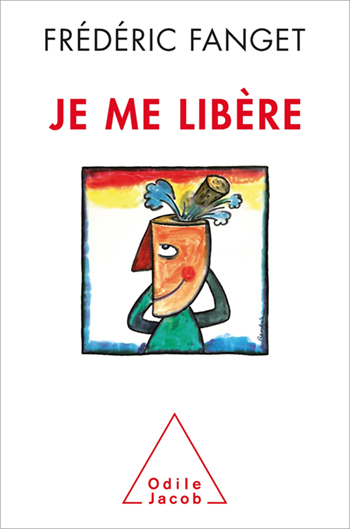
Frédéric Fanget
Getting Rid Of All Those Demands We Make on Ourselves
The book that shows you how to accept yourself and find freedom and serenity

Rita Levi Montalcini
Your Future A Nobel Prize which speaks to young people
When a great scientist makes a point of getting through to young people and those around them.... When a Nobel prize brings within everyones reach all the key principles of biology.... When an exceptional woman passes down to new generations the values on which she has based her life.... Science with a conscience ! Rita Levi Montalcini recieved the Nobel Prize for Medicine. Born in Turin, but forced from Italy by the Fascism, she has for many years taught in the United States.

Michel Baroin
The Power of Love
Defining who I am, what I believe in, and where I exercise my responsabilities, whether within my family, the city, or the companies I am in charge of; taking from this experience a message of hope for the future, a moral for the individual, a conception of society: this is the aim of this essay, written by M. Baroin, the former Grand Master of the Grand-Orient de France, who died in an aircrash in 1987.

Charles Millon
Internal Peace
With regard to those who deny the fundamental and cardinal principals of law, which are the absolute respect of the dignity of the human person, the respect of each man whatever his race, class or religion and the eminent and equal dignity of each person; with regard to those who adopt a mindset of hatred, of cynicism and contempt, it is not only out of the question to collude with these people in any way, it is also necessary to fight against them and have the courage to exclude them. Charles Millon, a former Defence Minister and currently deputy mayor of Belley, gives us in this book an insight into his analysis of politics, his personal agenda, his strategy, and his proposals for the law, and for France, so that each one of us can make a judgement with full knowledge of the facts.
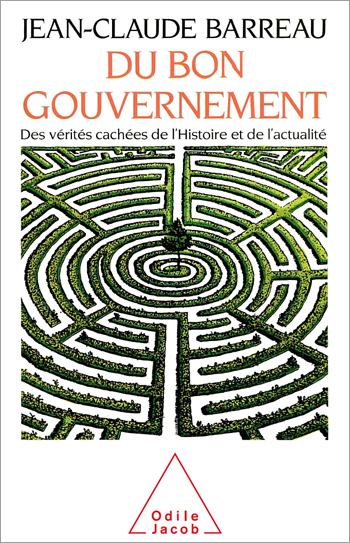
Jean-Claude Barreau
Of Good Government The Hidden Truths of History and the News
For the edification of the citizens that we are, the author examines philosophical problems that we had considered resolved since the 18th century, in light of current events. A powerful demonstration of the secret pillars of power, which underlines the necessity of the social contract. Jean-Claude Barreau is the Inspector General of National Education, and has held various positions in high-level administration.

Yves-Alexandre Thalmann
We Always Have a Second Chance at Happiness A little lesson in happiness
An original approach to happiness: memories have an immense potential for happiness. An overview of discoveries in the neurosciences, in particular on the functioning of memory and of cognitive biases. A renewed approach to the resources of our mental mechanisms.
Pierre-André deChalendar
For a City That Is Desirable Once Again Cities are our future: what can be done so they will ultimately be desirable again?
Should we leave cities? The subject is very timely, and this book, which argues that we shouldn’t, deals with it intelligently, and without being overly-technical, which is rather rare in the realm of urbanism.

Étienne Ghys
Snowflakes: A Wonder of Nature
An introduction to the science of crystals within the reach of non-specialists, with a very clear introduction to the physical and mathematical aspects of the subject.

Catherine Bonnet
A Gesture of Love Giving birth anonymously
Why do some women give birth anonymously so that their child is instantly adopted? A pedopsychoanalyst, Catherine Bonnet recounts the heart-breaking testimonies of these suffering women whose single gesture of love is to protect their child from the violence within themselves. A fresh look at the foundations of maternity and of filiation. Catherine Bonnet is a pedopsychoanalyst.
Paul Milliez
My Hopes
How does a traditionally-educated Catholic become a committed doctor? How do the resistance, the fight for abortion and against all forms of intolerance, intimate relationships with world leaders from General de Gaulle to the Shah of Iran and travels from Liban to Saudi Arabia, combine to create an extraordinary personality? A worldwide specialist in arterial hypertension, Paul Milliez (1912-1994) was the honorary dean of faculty at Broussais Hotel-Dieu.
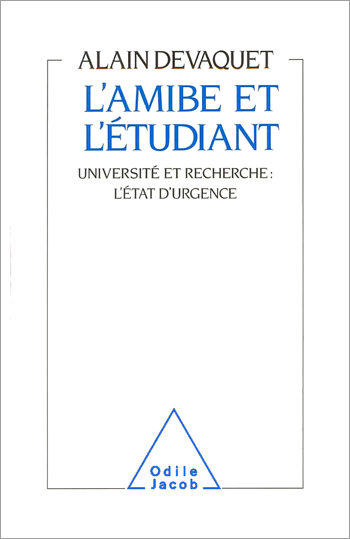
Alain Devaquet
The Amoeba and the Student University and Research: A State of Emergency
The student revolt of December 1986 translated the profound disarray of a university world faced with the mutations at work in modern-day France. In an analysis of the causes of the events that led to the repeal of his project of law on the universities. Alain Devaquet underlines the importance of the stakes represented by higher education and research on the future of a country and formulates an ensemble of propositions in light of their development. Alain Devaquet is a former minister of higher education and research, and a professor at the faculty of sciences of Paris.