
Catalog All books
Jean-Luc Ducher
Overcoming Anxiety All By Yourself
An accessible approach in the form of 100 questions/answers on an ever-present subject
Georges Duby
History Continues
“I have undertaken to talk, soberly and informally, of my profession...
Éric Dubreuil
Parents of the Same Sex
A growing number of gay men and women have founded families and are discovering the joys of parenting. It is estimated that there are approximately 500,000 families headed by parents of the same sex. They have brought the issue of homosexual parenting into the public arena, shattering traditional notions of the family and raising fundamental questions of filiation, adoption, and medically assisted procreation (artificial insemination, surrogate mothers) which go beyond the sphere of homosexuality and concern the future of our societyand therefore of all of us. Based on 29 interviews, including seven of children and teenagers, the book explores the little-known lives of same-sex-parent families.
Pierre Bergé, Yves Pomeau, Monique Dubois-Gance
From Rhythm to Chaos
From the physics of particules to astronomy, from chemistry to biology, chaos is present in most scientific fields. Three specialists of this subject have undertaken, through many examples, to extract chaos from the scientific world in order to show how strong is its hold on our daily lives.
Emmanuel Dubois de Prisque
China and its Demons At the Source of Sino-Totalitarianism
Emmanuel Dubois de Prisque is tackling a taboo by showing how Chinese culture participates in totalitarianism, and by asserting that the CCP identifies as a sacred sovereign.
Roger-Pol Droit
101 Experiences of Daily Philosophy
This highly original book consists of 101 short texts, each describing an experiment or something to do. Although the practical exercises are easy to accomplish, they are often disconcerting and will make the reader aware of how strange an apparently banal action can seem. Their purpose is philosophical: the goal being to experience the unexpected through simple actions and events. Roger-Pol Droit intends to shake up the certainties that underlie our identity, speech, relations to time and space, and memory, and enable us to feel issues that are generally regarded as abstract. In his highly readable, incisive style he has succeeded in transforming ideas into feelings. Roger-Pol Droit is a philosopher and researcher at the Centre National de la Recherche Scientifique.
Dominique Desanti, Jean-Toussaint Desanti, Roger-Pol Droit
Liberty Still Cherishes Us
In this book, the authors, Dominique and Jean-Toussaint Desanti, relate their lives of active political and intellectual commitment to Roger-Pol Droit. The story begins with Dominique and Jean-Toussaints first meeting, their lives as an open couple, their involvement in the French Resistance and, later, in the Communist Party, their support of the FLN during the Algerian war of independence, their participation in the events of May 1968 in France and the United States, and their espousal of the feminist movement. They also discuss the numerous works they have written literature in Dominiques case, philosophy in Jean-Toussaints. Their political path is one that was shared by many French intellectuals of their generation. The enthusiasm of many young people for left-wing causes had first been stirred by the Popular Front government. The Soviet victory at Stalingrad (rather than support of Marxist thought) later fanned this enthusiasm, with the result that many French intellectuals joined the Communist Party. Each event in the authors lives is recounted individually from each ones point of view, before being retold by both of them in unison. This manner of telling their story fully respects each writers personality and style, and has resulted in an especially intense book. Dominique Desanti is a journalist, essayist and novelist. Jean-Toussaint Desanti is a philosopher and professor emeritus at the University of Paris I-Sorbonne.
Roger-Pol Droit
Recent News of Ordinary Objects
"Can you learn anything from ordinary objects the things you use in your daily life? The answer is: yes, more than you can imagine. During the course of one year, I assigned myself a sort of adventure: I kept a diary of my encounter with objects, and I suggest you do the same. Briefly, my goal was to try to find the words that are hidden inside objects, to discover the questions that lie at the heart of things. My journey took place in four stages: surprise, groping, panicking, feeling soothed. This experience, touched with humour and a hint of folly, also follows the itinerary of an unexpected spiritual journey," Roger-Pol Droit is a research fellow at the Centre National de la Recherche Scientifique
Roger-Pol Droit
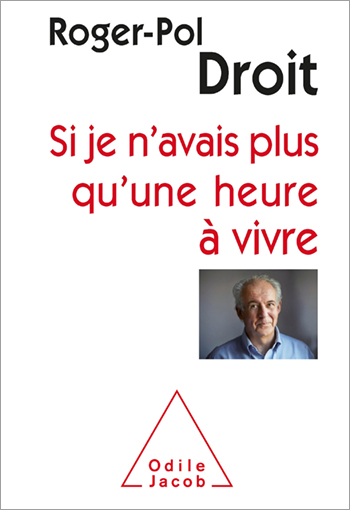
If I Had Only One More Hour to Live
In this final, radical work, Roger-Pol Droit offers the reader a brilliant philosophy lesson
Roger-Pol Droit
The Company of Philosophers
Roger-Pol Droit takes the reader on a voyage through time, spanning the centuries from Antiquity to the present, in a series of intellectual portraits of great and usual or remarkable thinkers, beginning with Socrates and Plato and ending with Michel Foucault and Gilles Deleuze. A major part of this volume is devoted to modern philosophers, from Kant to Heidegger. The author's goal is to stimulate new thought and to bring to life for the reader the vital ideas of past thinkers.