
Catalog All books



Jean-Pierre Petit
The Stock Exchange Renewal and Rupture
The current stock market crisis followed the period of fastest growth in world markets in history. How can this be explained? And what does it indicate for the future? While the bullish market that preceded the crisis was hyper-inflationist, we are now experiencing a period of deflation, a drop following on the heels of a vertiginous rise. In this respect, Petits interpretation is that of the regulationists: the crisis is one of confidence. He also describes how the crisis has revealed structural weaknesses in various countries. Jean-Pierre Petit is head of economic research for the investment company Exane.
Frank Dangeard
Crisis Decision-Making in Businesses 12 Tales of Governance
Based on his extensive experience as a manager and administrator, and illustrated with numerous examples from recent business history...


Robert Boyer
General Theory of Capitalism is it possible?
Robert Boyer is a leading figure of the regulationist school of economics, which believes that capitalism requires external, political, monetary and social regulations, and that the capitalist economy cannot be reduced to the self-regulating laws of the market. In this book, he proposes a general theory of capitalism, from two angles. First of all, he argues that there are several models of capitalism - not just one. America's ultra-liberal capitalism is unlike German capitalism, which is characterised by the fusion between banks and businesses, just as it is unlike French state-interventionist capitalism and Japan's capitalism of consensus. Secondly, in order to understand how capitalism works, every aspect has to be considered - not just the market but also political and social institutions (the State, central banks, unions, etc.) and the conventions they create among themselves (salary agreements, etc.). Robert Boyer is a research fellow at the Centre National de la Recherche Scientifique, a director of studies at the Ecole des Haute Etudes en Sciences Sociales and a member of the French prime minister's Council for Economic Analysis.
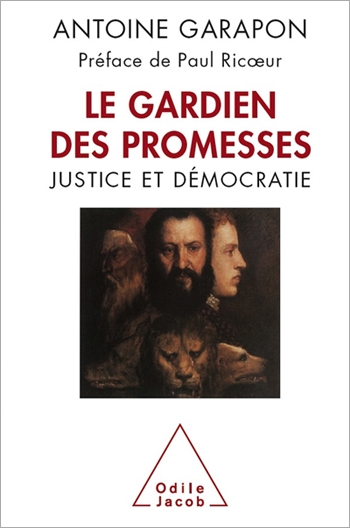
Antoine Garapon
The Guardian of Promises Justice and Democracy
The multiplying cases, the explosion of litigations, the sensational trials which catch the attention of the public : all are evidence of a growth in power of the judicial system, which we expect to be, at the same time, the arbiter of morals, the guarantee of public morality and responsible for the salvation of the people. But why dont we ask what things it cannot provide ? Isnt the idea of a judicial democracy just an illusion, which serves to hide serious problems ? The power of the judicial system is more worrying than exciting. It is an indicator of the discreditation of the State at the same time as a reduction in social cohesion. In the face of the fragility of democratic society, this book is a thorough reflection on the exercise of public power, affirming that the real role of the judge is not to take the place of the politic, but to diffuse the risk of democratic implosion by remaining the guardian of the promises at the very heart of republican laws. Antoine Garapon, a former judge and member of the editorial team of the journal Esprit, is the head of the Institute of Advanced Judicial Studies.
Dominique Reynié
Europeans in 2004
What does Europe's future hold? To answer this question, Dominique Reynié examines trends and developments in Europe's civil society, current events, and the debates and ideas currently under public discussion in the E.U. and in the rest of Europe. The information included here covers statistics and opinion polls; political events; political, economic and social issues; legal and constitutional questions; as well as European character traits, mind-sets and lifestyles. This is an indispensable work for anyone who wishes to become familiar with the reality of Europe in flux. Also included here is a unique synthesis of election results in all of Europe during the past year. Dominque Reynié teaches at the Institut d'Etudes Politiques, in Paris, and is the director of the Observatoire Interrégional du Politique. He is most notably the author of Le Triomphe de l'Opinion Publique.



Pierre Buser
Neurophilosophy of the Brain Neurons That Aspire to Explain the Mind
A highly topical discussion, linked to the latest findings in the neurosciences: is it still relevant nowadays, given recent neurobiological research.


Arielle Adda, Hélène Catroux
The Gifted Child Reconciling Intelligence
Exceptionally gifted, gifted and intellectually precocious children make up as much as 5 % of any given age group. Yet they often seek failure, both at school and in their personal lives, because they suffer from being different from other children. This book is addressed to the parents and teachers of gifted children. Besides reviewing the current state of knowledge on the subject, it explains how such children can be taught to manage their potential and to overcome their excessive sensitivity and weaknesses. Arielle Adda is a psychologist. Hélène Catroux is an educational psychologist.