Catalog All books
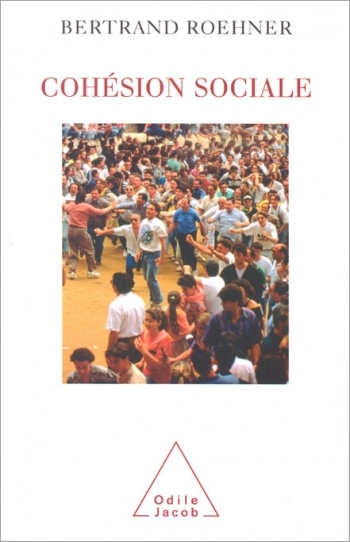
Bertrand Roehner
Social cohesion
The methodology of physics is now being applied to the social sciences. Social cohesion, which assures social stability and continuity, is both observable and measurable. It may be observed in events that repeat: in test events such as the destruction of the mosque in Ayodhya, India (1992), and of the twin towers of the World Trade Center in Manhattan (2001); in catastrophes such as the Great Fire of London (1666), the earthquakes and fires of San Francisco (1906) and Tokyo (1923); in the riots of rejection in Lawrence, Mass., U.S.A. (1984), and in Aigues-Mortes, France (1893); in the protest riots in Brixton, U.K. (1981); and in resistance to foreign occupation, as in France (1940). Social cohesion can be measured through the reactions of a given society in the aftermath of a shock: for example, in the number of Hindu temples that were burned down or mosques that were destroyed following the first two test events listed above. By borrowing the methods of physics, social scientists have been able to make predictions in their own field. Bertrand Roehner is a member of the Laboratory of Theoretical Physics at Pierre et Marie Curie-University of Paris VII. He is the author of Un siècle de commerce du blé en France (Economica), Theory of Markets (Springer), Application of Physics in Economic Modelling, Pattern and Repertoire in History (Harvard University Press) and Separatism and Integration (Rowman and Littlefield).
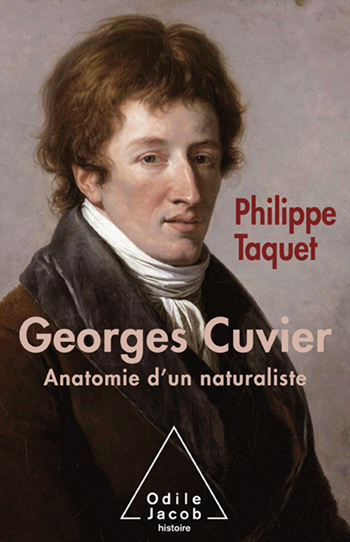
Philippe Taquet
Georges Cuvier Anatomy of a Naturalist
The second of three volumes, this one dealing with scientific work between 1795 and 1803; the third will deal with the later years of the greatest biologist of his time.

Barbara Demeneix
Losing Our Minds How Environmental Pollution Impairs Human Intelligence and Mental Health
The global prevalence of neurodevelopmental disorders is accelerating. Numbers of children affected.
James Watson
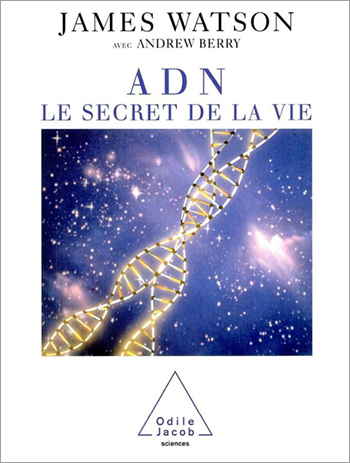
DNA The Secret of Life
Fifty years ago, when he was only 24, James Watson contributed to cracking the genetic code and thus helped resolve one of the greatest scientific mysteries of our age. In DNA: The Secret of Life, he goes back in time and offers an overall view of the genetic revolution. He gives us the keys to understanding the molecular foundations of life and shows to what extent our knowledge of genetics affects how we regard our origins and our own identity. Drawing on his long experience at the forefront of genetic research, he examines the brave new world that lies before us all and the consequences of the genetic revolution. James D. Watson is best known as the co-discoverer, with Francis Crick and Maurice Wilkins, of the molecular structure of DNA. For this accomplishment, the three men shared the 1962 Nobel Prize for Physiology or Medicine. In 1968, he was appointed director of Cold Spring Harbor Laboratory, on Long Island, New York, and has served as its president since 1994. Andrew Berry is a junior fellow at the Museum of Comparative Zoology at Harvard University
Roger Penrose
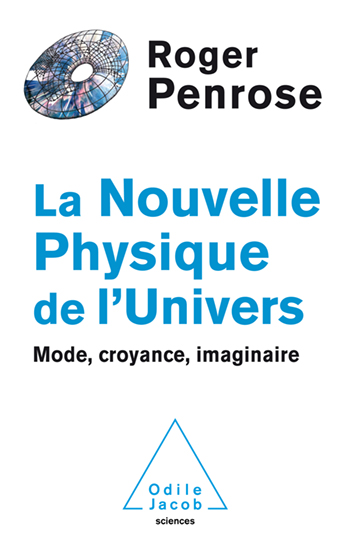
Fashion, Faith, and Fantasy in the New Physics of the Universe The Big Bang and the effect of fashion
Roger Penrose is a world-renowned theoretical physicist. The author of many books on cosmology, he is emeritus professor of mathematics at the University of Oxford.

Pierre Grosser
The History of the World is Made in Asia Another vision of the twentieth century
A "de-westernized" story: many episodes that are often overlooked are described here — the Russian civil war in the Far East, the Anglo-Japanese confrontation in Manchuria, the harshness of the Korean War…